
Rectangle Area and Geometric Construction
Loading the math board and drawing, please wait…
In collections
Area, Surface Area, Volume--Nets
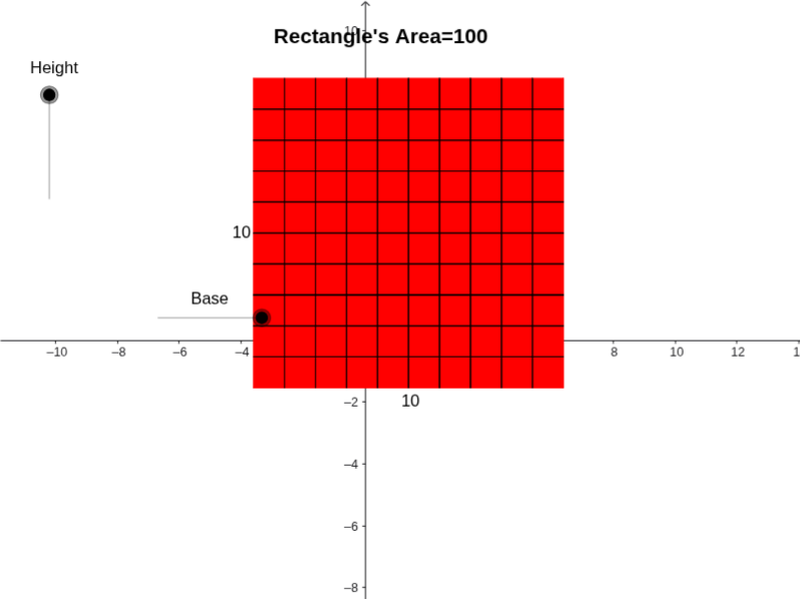
①This GeoGebra example demonstrates the area of a rectangle through dynamic geometric construction, combining points, segments, circles, perpendicular lines, and polygons. ②Core mathematical concepts include the rectangle area formula, geometric construction techniques, and the use of midpoints and perpendiculars to explore area relationships, potentially linking to definite integrals, median values, and statistical characteristics as indicated by original tags. ③Construction highlights: Based on the summary, commands such as Point, Segment, Circle, OrthogonalLine, Intersect, Polygon, and Midpoint are used, creating objects like Base, Height, A, B, C, D, E, F, G, and more, forming a complete rectangle with auxiliary figures. ④Target audience: Suitable for middle school to high school students, useful for geometry lessons, area concept understanding, and dynamic exploration of rectangle properties and related mathematical relations, also valuable for teacher demonstrations or student self-study.
GeoGebra Commands & Parameters
Point(Circle[A, Base]) → BSegment(A, B) → bPoint(Circle[A, Height]) → CSegment(A, C) → dCircle(A, C) → eOrthogonalLine(A, b) → fIntersect(e, f, 1) → DOrthogonalLine(B, b) → gOrthogonalLine(D, f) → hIntersect(g, h) → EPolygon(A, D, E, B) → P, a_1, d_1, e_1, b_1Midpoint(A, D) → FMidpoint(A, B) → GPoint(Circle[A, 1]) → HSegment(A, H) → iPoint(Circle[A, 2]) → ISegment(A, I) → jPoint(Circle[A, 3]) → JSegment(A, J) → kPoint(Circle[A, 4]) → KSegment(A, K) → lPoint(Circle[A, 5]) → LSegment(A, L) → mPoint(Circle[A, 6]) → MSegment(A, M) → nPoint(Circle[A, 7]) → NSegment(A, N) → pPoint(Circle[A, 8]) → OSegment(A, O) → qPoint(Circle[A, 9]) → QSegment(A, Q) → rCircle(A, H) → sCircle(A, I) → tCircle(A, J) → c_1Circle(A, K) → f_1Circle(A, L) → g_1Circle(A, M) → h_1Circle(A, N) → k_1Circle(A, O) → p_1Circle(A, Q) → q_1Intersect(s, a_1, 1) → RIntersect(t, a_1, 1) → SIntersect(c_1, a_1, 1) → TIntersect(f_1, a_1, 1) → UIntersect(g_1, a_1, 1) → VIntersect(h_1, a_1, 1) → WIntersect(k_1, a_1, 1) → YIntersect(p_1, a_1, 1) → ZIntersect(q_1, a_1, 1) → A_1Intersect(q_1, b_1, 1) → B_1Intersect(p_1, b_1, 1) → C_1Intersect(k_1, b_1, 1) → D_1Intersect(h_1, b_1, 1) → E_1Intersect(g_1, b_1, 1) → F_1Intersect(f_1, b_1, 1) → G_1Intersect(c_1, b_1, 1) → H_1Intersect(t, b_1) → I_1,Intersect(s, b_1, 1) → J_1OrthogonalLine(R, a_1) → i_1OrthogonalLine(S, a_1) → j_1OrthogonalLine(T, a_1) → l_1OrthogonalLine(U, a_1) → m_1OrthogonalLine(V, a_1) → n_1OrthogonalLine(W, a_1) → r_1OrthogonalLine(Y, a_1) → s_1OrthogonalLine(Z, a_1) → t_1OrthogonalLine(A_1, a_1) → a_2OrthogonalLine(J_1, b_1) → b_2OrthogonalLine(I_1, b_1) → c_2OrthogonalLine(H_1, b_1) → d_2OrthogonalLine(G_1, b_1) → e_2OrthogonalLine(F_1, b_1) → f_2OrthogonalLine(E_1, b_1) → g_2OrthogonalLine(D_1, b_1) → h_2OrthogonalLine(C_1, b_1) → i_2OrthogonalLine(B_1, b_1) → j_2Intersect(b_2, d_1) → K_1Intersect(c_2, d_1) → L_1Intersect(d_2, d_1) → M_1Intersect(e_2, d_1) → N_1Intersect(f_2, d_1) → O_1Intersect(g_2, d_1) → P_1Intersect(h_2, d_1) → Q_1Intersect(i_2, d_1) → R_1Intersect(j_2, d_1) → S_1Intersect(a_2, e_1) → T_1Intersect(t_1, e_1) → U_1Intersect(s_1, e_1) → V_1Intersect(r_1, e_1) → W_1Intersect(n_1, e_1) → Y_1Intersect(m_1, e_1) → Z_1Intersect(l_1, e_1) → A_2Intersect(j_1, e_1) → B_2Intersect(i_1, e_1) → C_2Segment(J_1, K_1) → k_2Segment(I_1, L_1) → l_2Segment(H_1, M_1) → m_2Segment(G_1, N_1) → n_2Segment(F_1, O_1) → p_2Segment(E_1, P_1) → q_2Segment(D_1, Q_1) → r_2Segment(C_1, R_1) → s_2Segment(B_1, S_1) → t_2Segment(R, C_2) → a_3Segment(B_2, S) → b_3Segment(T, A_2) → c_3Segment(Z_1, U) → d_3Segment(V, Y_1) → e_3Segment(W_1, W) → f_3Segment(Y, V_1) → g_3Segment(U_1, Z) → h_3Segment(A_1, T_1) → i_3Intersect(q_1, a_1) → D_2, D_4Intersect(p_1, a_1) → E_2, E_4Intersect(k_1, a_1) → F_2, F_4Intersect(h_1, a_1) → G_2, G_4Intersect(g_1, a_1) → H_2, H_4Intersect(f_1, a_1) → I_2, I_4Intersect(c_1, a_1) → J_2, J_4Intersect(t, a_1) → K_2, K_3Intersect(c_1, b_1) → L_2, L_3Intersect(f_1, b_1) → M_2, M_3Intersect(g_1, b_1) → N_2, N_3Intersect(h_1, b_1) → O_2, O_3Intersect(k_1, b_1) → P_2, P_3Intersect(q_1, b_1) → Q_2, Q_3Intersect(p_1, b_1) → R_2, R_3OrthogonalLine(D_2, a_1) → aOrthogonalLine(E_2, a_1) → cOrthogonalLine(F_2, a_1) → j_3OrthogonalLine(G_2, a_1) → k_3OrthogonalLine(H_2, a_1) → l_3OrthogonalLine(I_2, a_1) → m_3OrthogonalLine(J_2, a_1) → n_3OrthogonalLine(K_2, a_1) → p_3OrthogonalLine(L_2, b_1) → q_3OrthogonalLine(M_2, b_1) → r_3OrthogonalLine(N_2, b_1) → s_3OrthogonalLine(O_2, b_1) → t_3OrthogonalLine(P_2, b_1) → a_4OrthogonalLine(R_2, b_1) → b_4OrthogonalLine(Q_2, b_1) → c_4Intersect(q_3, d_1) → U_2Intersect(r_3, d_1) → V_2Intersect(s_3, d_1) → W_2Intersect(t_3, d_1) → Y_2Intersect(a_4, d_1) → Z_2Intersect(b_4, d_1) → A_3Intersect(c_4, d_1) → B_3Intersect(e_1, a) → C_3Intersect(e_1, c) → D_3Intersect(e_1, j_3) → E_3Intersect(e_1, k_3) → F_3Intersect(e_1, l_3) → G_3Intersect(e_1, m_3) → H_3Intersect(e_1, n_3) → I_3Intersect(p_3, e_1) → J_3Segment(U_2, L_2) → d_4Segment(M_2, V_2) → e_4Segment(W_2, N_2) → f_4Segment(O_2, Y_2) → g_4Segment(Z_2, P_2) → h_4Segment(R_2, A_3) → i_4Segment(B_3, Q_2) → j_4Segment(J_3, K_2) → k_4Segment(J_2, I_3) → l_4Segment(H_3, I_2) → m_4Segment(H_2, G_3) → n_4Segment(F_3, G_2) → p_4Segment(F_2, E_3) → q_4Segment(D_3, E_2) → r_4Segment(D_2, C_3) → s_4