
Rearrangement Proof of the Pythagorean Theorem
Loading the math board and drawing, please wait…
In collections
Pythagorean Theorem
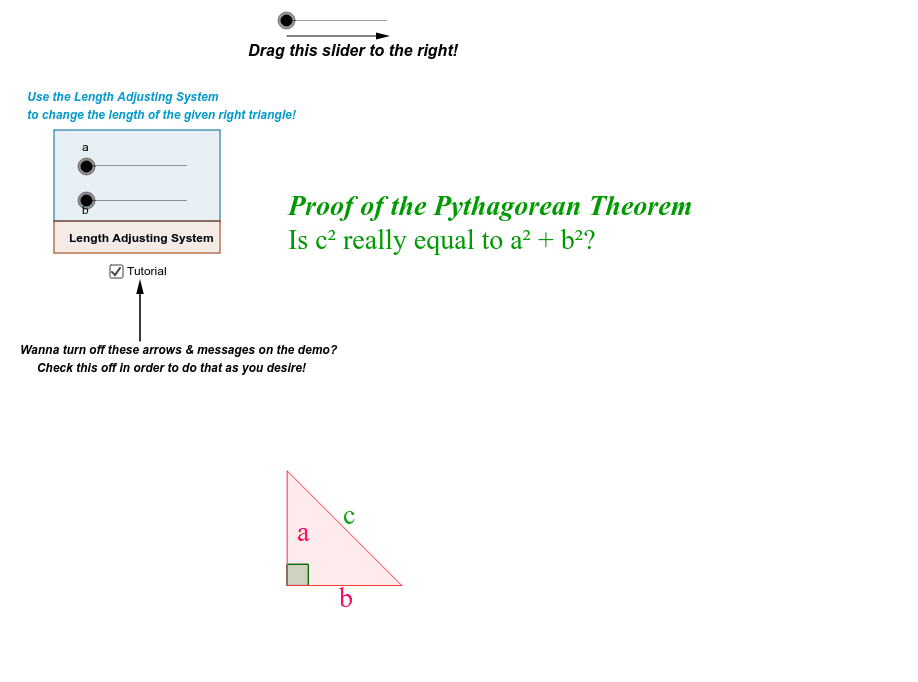
This example demonstrates the famous 'rearrangement' proof of the Pythagorean Theorem, showing the theorem through the movement and rearrangement of shapes. The core math concepts involved are the Pythagorean Theorem and geometric transformations. Construction highlights include using commands and objects like Polygon, Midpoint, Ray, Rotate, Circle, Segment, Angle, Centroid, Line, Point, OrthogonalLine, Intersect, and Vector in GeoGebra. Suitable for middle school students and above to learn geometric proof methods.
GeoGebra Commands & Parameters
Polygon(A, C, B) → poly1, b_1, a_1, c_2Midpoint(b_1) → MRay(B, M) → n_2Rotate(B, (-(((90 * Progress_4))°)), B) → B'Circle(B', sqrt(b^(2) + ((0.5 * a))^(2)) - 0.1) → d_3Rotate(L, ((90 * Progress_2))°, J) → L'Rotate(L', ((Progress_3 * 90))°, L') → L''Circle(L'', sqrt(a^(2) + ((0.5 * b))^(2)) - 0.1) → c_3Rotate(K, ((90 * Progress_2))°, J) → K'Polygon(J, K', L') → poly4, l', j, k'Midpoint(l') → ZRay(L', Z) → m_2Rotate(E, ((90 * Progress))°, D) → E'Rotate(F, ((90 * Progress))°, D) → F'Polygon(F', D, E') → poly2, e', f', dRotate(H, ((90 * Progress_1))°, G) → H'Rotate(I, ((90 * Progress_1))°, G) → I'Polygon(H', I', G) → poly3, g, h', i'If(Progress ≟ 0, 0, 1) → eIf(Progress_1 ≟ 0, false, true) → hRotate(J, ((Progress_3 * 90))°, L') → J'Rotate(K', ((Progress_3 * 90))°, L') → K''Polygon(J', K'', L'') → poly4', l'', j', k''If(Progress ≟ 1, If[Progress_1 ≟ 0, true, false], true) → Progress_{visibility}If(Progress ≟ 1, If[Progress_2 ≟ 0, true, false], false) → Progress1_{visibility}Polygon(C, A, B) → poly5, b_2, c_1, a_2Rotate(C, (-(((90 * Progress_4))°)), B) → C'Rotate(A, (-(((90 * Progress_4))°)), B) → A'Polygon(C', A', B') → poly5', b', c', a'If(Progress_2 ≟ 0, false, If[Progress_3 ≟ 0, true, false]) → iIf(Progress_3 ≟ 0, true, false) → kIf(Progress_1 ≟ 1, If[Progress_3 ≟ 0, true, false], false) → Progress2_{visibility}If(Progress_3 ≟ 0, false, true) → lSegment(J, A) → mSegment(A, D) → nSegment(D, G) → pSegment(G, J) → qIf(Progress_2 ≟ 1, true, false) → squareAngle(B, A, C) → αAngle(E', D, F') → βAngle(H', G, I') → γAngle(K', J, L') → δIf(Progress ≟ 1, true, false) → Right1If(Progress_1 ≟ 1, true, false) → Right2Angle(E', F', C) → εAngle(H', I', F') → ζAngle(C, H', I') → ηAngle(B, C, H') → θIf(Progress ≟ 1, If[Progress_3 ≟ 0, true, false], false) → Blue1If(Progress_1 ≟ 1, If[Progress_3 ≟ 0, true, false], false) → Blue2If(Progress_2 ≟ 1, If[Progress_3 ≟ 0, true, false], false) → Blue3Polygon(C, L', E', B) → poly6, r, s, t, d_1If(Progress_2 ≟ 1 ∧ Progress_3 ≟ 0, true, false) → CsquarePolygon(J, L, J', L') → poly7, j_1, l_1, j'_1, l'_1Polygon(L, A, B, A') → poly8, l_2, a_3, b_3, a'_1Angle(J, L', J') → ιAngle(L', J', L) → κAngle(J', L, J) → λAngle(L, A', B) → μAngle(A', B, A) → νAngle(A, L, A') → ξIf(Progress_3 ≟ 1, true, false) → BluesquaresMidpoint(c_2) → NMidpoint(a_1) → OMidpoint(e') → PMidpoint(f') → QMidpoint(d) → RMidpoint(h') → SMidpoint(i') → TMidpoint(g) → UIf(Progress_1 ≟ 1, true, false) → Legs_{3rd}Midpoint(k') → VMidpoint(j) → WIf(Progress ≟ 1, If[Progress_3 ≟ 0, true, false], false) → Hypo_{2nd}If(Progress_1 ≟ 1, If[Progress_3 ≟ 0, true, false], false) → Hypo_{3rd}If(Progress_2 ≟ 1, If[Progress_3 ≟ 0, true, false], false) → Hypo_{4th}Centroid(poly6) → A_1If(Progress ≟ 1, true, false) → Legs_1If(Progress_2 ≟ 1, If[Progress_3 ≟ 0, true, false], false) → Legs_{4th}Midpoint(l'_1) → B_1Midpoint(k'') → C_1Midpoint(j_1) → D_1Midpoint(l_1) → E_1Midpoint(a'_1) → F_1Midpoint(b_3) → G_1Midpoint(a_3) → H_1Midpoint(l_2) → I_1If(Progress_3 ≟ 1, true, false) → BluelabelsIf(Progress_2 ≟ 1 ∧ Progress_3 ≟ 0, true, false) → textofcsquaredCentroid(poly7) → J_1Centroid(poly8) → K_1If(Progress_3 ≟ 1, true, false) → aandbsquaredsLine(L_1, yAxis) → cLine(M_1, yAxis) → e_1Point(c) → N_1OrthogonalLine(N_1, c) → f_1Point(c) → O_1OrthogonalLine(O_1, c) → g_1Point(c) → P_1OrthogonalLine(P_1, c) → h_1Intersect(e_1, f_1) → Q_1Intersect(e_1, g_1) → R_1Intersect(e_1, h_1) → S_1Polygon(P_1, O_1, R_1, S_1) → poly9, p_1, o_1, r_1, s_1Polygon(O_1, N_1, Q_1, R_1) → poly10, o_2, n_1, q_1, r_2If(Progress ≟ 0, true, false) → TitleSegment(T_1, U_1) → i_1Segment(U_1, V_1) → k_1Segment(V_1, W_1) → m_1Segment(W_1, T_1) → t_1If(Progress ≟ 0, true, false) → oVector(Z_1, A_2) → uLine(A_2, u) → d_2Point(d_2) → E_2Point(d_2) → F_2Vector(E_2, F_2) → zIf(Tutorial ≟ true, If[Progress ≟ 0, true, false], false) → tutorial_{1st(2)}If(Tutorial ≟ true, If[Progress ≟ 0 ∨ Progress ≟ 1, false, true], false) → tutorial_{1stto2nd}If(Tutorial ≟ true, If[Progress ≟ 0, true, false], false) → tutorial_{1st}If(Tutorial ≟ true, If[Progress ≟ 1 ∧ Progress_1 ≟ 0, true, false], false) → Tutorial_{2nd}If(Tutorial ≟ true, If[Progress ≟ 1, false, true], false) → Vector_1Angle(K'', J', L'') → οAngle(B', A', C') → ρRay(G, J) → e_2Ray(D, A) → f_2OrthogonalLine(G_2, f_2) → g_2Intersect(g_2, f_2) → H_2Segment(G_2, J) → h_2Segment(H_2, A) → i_2Midpoint(G_2, H_2) → I_2Vector(I_2, G_2) → z_1Vector(I_2, H_2) → u_2If(Progress_2 ≟ 1, true, false) → aplusbCircle(L'', (0.5 * a)) → k_2Point(k_2) → J_2Segment(L'', J_2) → j_2Rotate(J_2, ((90 * Progress_3))°, L'') → K_2Circle(B', (0.5 * b)) → p_2Point(p_2) → L_2Rotate(L_2, (-(((90 * Progress_3))°)), B') → M_2If(Progress_3 ≟ 0, false, true) → StillaandbIf(Progress_3 ≟ 0 ∨ Progress_3 ≟ 1, false, true) → movingaandbIf(Progress_3 ≟ 0, false, true) → movingrightanglesCircle(L'', sqrt(a^(2) + ((0.5 * b))^(2))) → q_2Circle(B', sqrt(b^(2) + ((0.5 * a))^(2))) → s_2Point(q_2) → N_2Point(s_2) → O_2Rotate(N_2, ((90 * Progress_3))°, L'') → P_2Rotate(O_2, (-(((90 * Progress_3))°)), B') → Q_2Intersect(c_3, m_2) → R_2,Rotate(R_2, ((90 * Progress_3))°, L'') → T_2Intersect(d_3, n_2) → S_2,Angle(J, L'', J') → σAngle(A', B', A) → τIf(Progress_4 ≟ 1, true, false) → SecondBlueSquareIf(Progress_3 ≟ 1, true, false) → Progress4_{visibility}If(Progress_2 ≟ 1, If[Progress_4 ≟ 0, true, false], false) → Progress3_{visibility}If(Progress_4 ≟ 0, true, false) → Hypo_{1st}If(Progress_4 ≟ 0, true, false) → Legs_{1st}If(Progress_2 ≟ 1, If[Progress_3 ≟ 1, false, true], false) → fakecsquaredIf(Progress_3 ≟ 1, If[Progress_4 ≟ 1, false, true], false) → SecondEquationVector(U_2, V_2) → v_2If(Progress ≟ 0, false, true) → fIf(Tutorial ≟ true, If[Progress_1 ≟ 1, false, true], false) → AnnoyingTutorial
AI Drawing Prompt Reference
Draw a right triangle and demonstrate the Pythagorean Theorem by moving and rearranging its parts. Start with a shape composed of the triangle's sides, then rotate and translate a part of it to combine with another part, forming a new shape. Use circles and lines to illustrate area relationships. The dynamic process shows the transformation and overlap of shapes, proving the geometric meaning of the theorem.
The prompt above was compiled from the original drawing commands and is for reference only.