
Ratios in a Right Angled Triangle
Loading the math board and drawing, please wait…
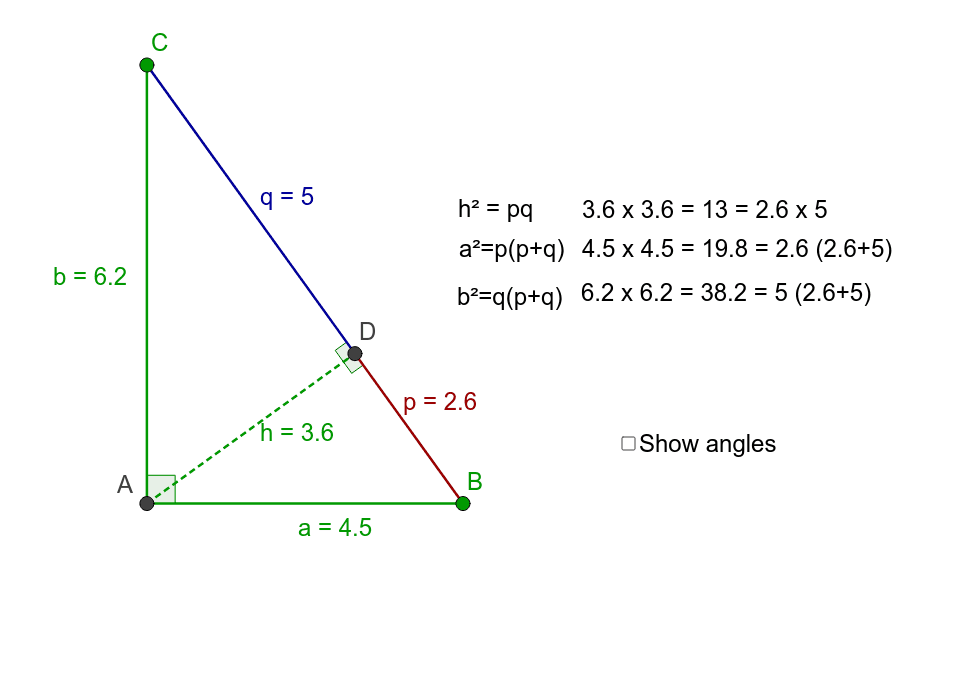
This example demonstrates the proportional relationships between the sides and angles in a right-angled triangle. Key mathematical concepts include trigonometry and the properties of similar triangles. Using the commands listed in the construction summary, a dynamic right-angled triangle is created to illustrate the relationships between side lengths and angles. Suitable for middle and high school students learning trigonometry and geometric construction.
GeoGebra Commands & Parameters
Intersect(xAxis, yAxis) → APoint(yAxis) → CPoint(xAxis) → BSegment(C, A) → bSegment(A, B) → aSegment(B, C) → cOrthogonalLine(A, c) → dIntersect(c, d) → DSegment(A, D) → hSegment(B, D) → pSegment(C, D) → qAngle(B, A, C) → αAngle(C, D, A) → βAngle(A, D, B) → γAngle(D, B, A) → δAngle(B, A, D) → εAngle(D, A, C) → ζAngle(A, C, D) → η
AI Drawing Prompt Reference
Draw a right-angled triangle to illustrate the relationships between sides and angles. The triangle is placed in a coordinate system with the right angle at the origin, and the legs extend along the x-axis and y-axis. The hypotenuse connects the endpoints of the legs. Calculate and label the right angle, acute angles, and obtuse angles to ensure the diagram is clear and understandable for students learning geometry and trigonometry.
The prompt above was compiled from the original drawing commands and is for reference only.