
Rational Number Sets
Loading the math board and drawing, please wait…
In collections
Rationale Zahlen & Arbeiten mit der Zahlengerade
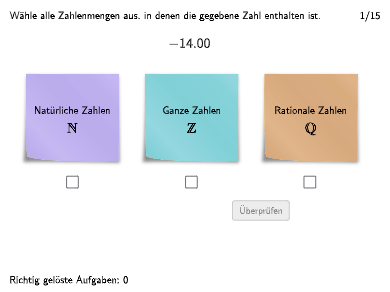
This example demonstrates the concept of rational number sets, involving the comparison and ordering of rational numbers, and their representation on the number line. It uses GeoGebra commands such as Join, Sequence, Zip, etc. Suitable for 7-8th grade students.
GeoGebra Commands & Parameters
Join({Sequence[Q0 + (m * (absnotes, 0)), m, 0, 2], {(0, -5), (0, -5), (0, -5)}}) → listPointsNotesSequence(Random[1, 1], m, 1, 110) → listCorrect1, {1, 1, 1, 1, 1, 1, 1, 1, 1, 1, 1, 1, 1, 1, 1, 1, 1, 1, 1, 1, 1, 1, 1, 1, 1, 1, 1, 1, 1, 1, 1, 1, 1, 1, 1, 1, 1, 1, 1, 1, 1, 1, 1, 1, 1, 1, 1, 1, 1, 1, 1, 1, 1, 1, 1, 1, 1, 1, 1, 1, 1, 1, 1, 1, 1, 1, 1, 1, 1, 1, 1, 1, 1, 1, 1, 1, 1, 1, 1, 1, 1, 1, 1, 1, 1, 1, 1, 1, 1, 1, 1, 1, 1, 1, 1, 1, 1, 1, 1, 1, 1, 1, 1, 1, 1, 1, 1, 1, 1, 1}Zip(RandomElement[{2, 2} \ {m}], m, listCorrect1) → listCorrect2Flatten(Join[{{7, 15, 8}, Shuffle[(1…15) \ {7, 15, 8}], Sequence[Shuffle[1…15], i, 1, 9]}]) → listExnumsIf(listsolhelp ≟ {0, 0, 1}, RandomElement[{{1, 3, 2}, {2, 3, 1}, {3, 2, 1}, {3, 1, 2}}], If[listsolhelp ≟ {0, 1, 1}, RandomElement[{{2, 1, 3}, {2, 3, 1}, {3, 1, 2}, {3, 2, 1}}], {1, 2, 3}]) → listChangedPositionsIf(shuffle, IndexOf[1, listChangedPositions], listCorrect1(Mod[questionCount, 100] + 1)) → posC1If(shuffle, IndexOf[2, listChangedPositions], listCorrect2(Mod[questionCount, 100] + 1)) → posC2RemoveUndefined({If[selected1, 1], If[selected2, 2], If[selected3, 3]}) → listselectedZip(RandomElement[{3, 3} \ {m, n}], m, listCorrect1, n, listCorrect2) → listCorrect3If(shuffle, IndexOf[3, listChangedPositions], listCorrect3(Mod[questionCount, 100] + 1)) → posC3RemoveUndefined({If[listsolhelp(1) ≟ 1, posC1], If[listsolhelp(2) ≟ 1, posC2], If[listsolhelp(3) ≟ 1, posC3]}) → listsolSequence(Random[1, 4], m, 1, 110) → listNote1, {4, 4, 1, 1, 3, 2, 3, 2, 4, 4, 1, 4, 3, 1, 3, 1, 3, 2, 4, 2, 1, 2, 2, 3, 4, 3, 2, 4, 2, 1, 2, 1, 1, 4, 3, 2, 2, 2, 4, 1, 4, 2, 4, 1, 2, 1, 4, 4, 4, 4, 1, 4, 1, 2, 2, 1, 1, 3, 4, 3, 1, 3, 1, 4, 1, 2, 3, 4, 2, 3, 3, 2, 3, 3, 4, 3, 4, 4, 1, 3, 2, 2, 4, 2, 3, 1, 3, 1, 2, 3, 2, 4, 4, 2, 2, 1, 4, 1, 2, 1, 4, 3, 3, 2, 4, 1, 2, 3, 3, 3}Zip(RandomElement[{5} \ {m}], m, listNote1) → listNote2Zip(RandomElement[{1, 2, 3, 4} \ {m, n}], m, listNote1, n, listNote2) → listNote3Zip(RandomElement[{1, 2, 3, 4} \ {m, n, j}], m, listNote1, n, listNote2, j, listNote3) → listNote4Sequence(P0 + (m * (abstext, 0)), m, 0, 2) → listPointsTextZip(RandomElement[{1, 2, 3} \ {m, n}], m, listCorrect1, n, listCorrect2) → listWrong3Textfield(input1) → InputBox1Textfield(input2) → InputBox2Polygon(PtopLeftCornerFeedback, PtopRightCornerFeedback, PbottomRightCornerFeedback, PbottomLeftCornerFeedback) → rectangleCorrect, rectangleCorrectS3, rectangleCorrectS4, rectangleCorrectS2, rectangleCorrectS1Shuffle(Sequence[Random[0, 10], i, 1, 100]) → randomNosForX, {1, 1, 7, 5, 4, 4, 8, 5, 10, 3, 0, 1, 9, 9, 4, 3, 7, 8, 5, 6, 5, 5, 3, 1, 5, 4, 3, 8, 2, 7, 7, 6, 7, 7, 3, 9, 1, 0, 0, 9, 0, 6, 6, 7, 8, 5, 6, 8, 5, 7, 2, 0, 8, 0, 7, 5, 10, 3, 0, 5, 6, 0, 7, 4, 5, 6, 4, 0, 2, 9, 0, 3, 0, 6, 10, 6, 3, 1, 10, 10, 10, 4, 8, 7, 3, 1, 4, 9, 9, 4, 6, 0, 1, 7, 5, 6, 5, 6, 3, 2}Shuffle(Sequence[Random[0, 10], i, 1, 100]) → randomNosForY, {2, 0, 7, 10, 2, 10, 9, 8, 6, 0, 7, 0, 10, 2, 10, 4, 2, 8, 5, 5, 1, 7, 8, 9, 10, 2, 1, 0, 9, 7, 2, 8, 9, 3, 7, 2, 8, 1, 0, 3, 1, 0, 1, 2, 0, 3, 9, 0, 3, 4, 2, 1, 3, 0, 0, 10, 5, 2, 7, 5, 3, 2, 0, 2, 6, 8, 1, 3, 2, 7, 0, 2, 6, 3, 8, 5, 7, 6, 10, 3, 9, 7, 7, 8, 2, 6, 5, 9, 3, 5, 3, 0, 8, 9, 1, 9, 9, 6, 10, 0}Append(true, Sequence[If[randomNosForX(i) ≟ randomNosForX(i - 1), false, true], i, 2, 100]) → stayXAppend(true, Sequence[If[randomNosForY(i) ≟ randomNosForY(i - 1), false, true], i, 2, 100]) → stayYRemove(Sequence[If[stayX(i), randomNosForX(i), 0], i, 1, 100], Sequence[0, i, 1, 100]) → randomNosForXwithoutRepeatRemove(Sequence[If[stayY(i), randomNosForY(i), 0], i, 1, 100], Sequence[0, i, 1, 100]) → randomNosForYwithoutRepeatElement(randomNosForXwithoutRepeat, Mod[questionCount, Length[randomNosForXwithoutRepeat]] + 1) → numXwithoutRepeatElement(randomNosForYwithoutRepeat, Mod[questionCount, Length[randomNosForYwithoutRepeat]] + 1) → numYwithoutRepeatNumberSeparationComma(numX) → Text3NumberSeparationComma(numY) → Text4NumberSeparationComma(numZ) → Text5Zip(RandomElement[{6} \ {m, n, j, l}], m, listNote1, n, listNote2, j, listNote3, l, listNote4) → listNote5Zip(RandomElement[{1, 2, 3, 4} \ {m, n, j, l, k}], m, listNote5, listNote1, n, listNote2, j, listNote3, l, listNote4, k) → listNote6Length(listsol) → numSolText(numAHelpText, midPointQuestionNumber, true, true, 0, 0) → Text1Defined(IndexOf[IndexOf[3, listChangedPositions], listselected]) → selectedShuffle3Defined(IndexOf[IndexOf[2, listChangedPositions], listselected]) → selectedShuffle2Defined(IndexOf[IndexOf[1, listChangedPositions], listselected]) → selectedShuffle1
AI Drawing Prompt Reference
Display the set of rational numbers in a coordinate system, marking points with different colors and showing their positions on a number line. Randomly generate multiple rational number points and connect them with lines to form a distribution on the number line. Some points are annotated with special symbols, and their order is randomly shuffled to demonstrate the comparison and ordering of rational numbers. Include randomly generated numbers and symbols in the background, along with some auxiliary text explanations.
The prompt above was compiled from the original drawing commands and is for reference only.