
Random Place Value Cards
Loading the math board and drawing, please wait…
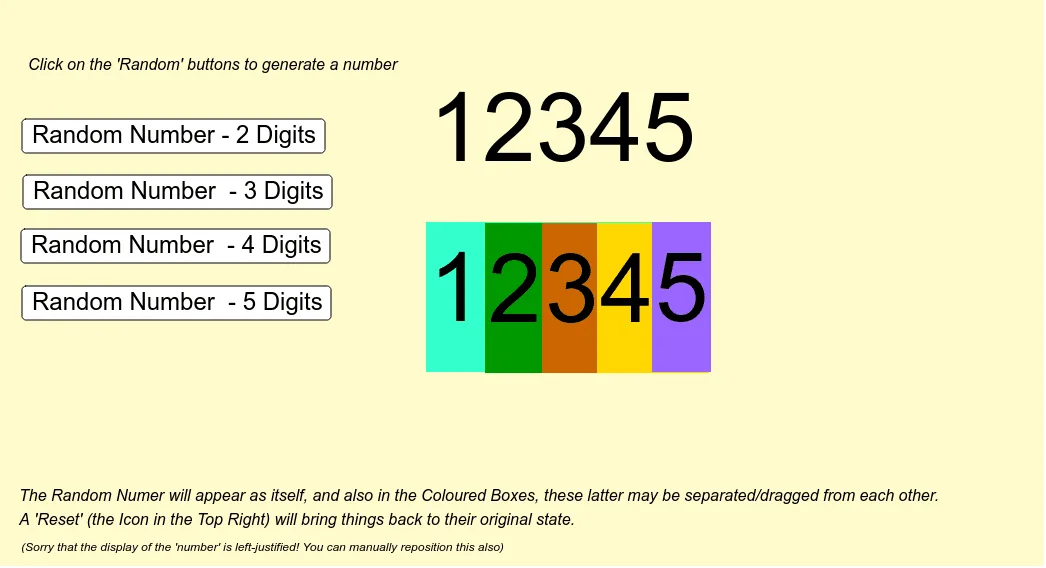
This example demonstrates how to create random place value cards using GeoGebra to showcase the structure of digits in numbers. The core math concepts involved include digit decomposition, natural number representation, and modular arithmetic. The construction highlights the use of GeoGebra commands such as Div (division), Length (length), Mod (modulus), and TableText (table text), along with objects like number (number), n (variable), tenthous (ten-thousands place), thous (thousands place), numero (number), digits (number of digits), hun (hundreds place), hundreds (hundreds place), thousands (thousands place), tenthousands (ten-thousands place), one (ones place), ten (tens place), tens (tens place), ones (ones place), text1 (text1), Rand10to99 (random number 10-99), Rand100to999 (random number 100-999), Rand1000to9999 (random number 1000-9999), Rand10000to99999 (random number 10000-99999), thousVis (thousands place visibility), tenthousVis (ten-thousands place visibility), hunVis (hundreds place visibility), text3 (text3), A (point), NumberDisplay (number display), text2 (text2), and text4 (text4). It is suitable for elementary and middle school mathematics education, focusing on digit learning and random number generation.
GeoGebra Commands & Parameters
Div(number, 10000) → tenthousLength(numero) → digitsMod(number, 10) → oneTableText({{number, " "}}, "vr") → NumberDisplay
AI Drawing Prompt Reference
Create an application showing the structure of five-digit numbers, randomly generated, with digits for the ten-thousands, thousands, hundreds, and ones places separated by spaces, and display the length of each digit, suitable for elementary and middle school math education focusing on digit learning and random number generation.
The prompt above was compiled from the original drawing commands and is for reference only.