
Ramsey Theory Demonstration
Loading the math board and drawing, please wait…
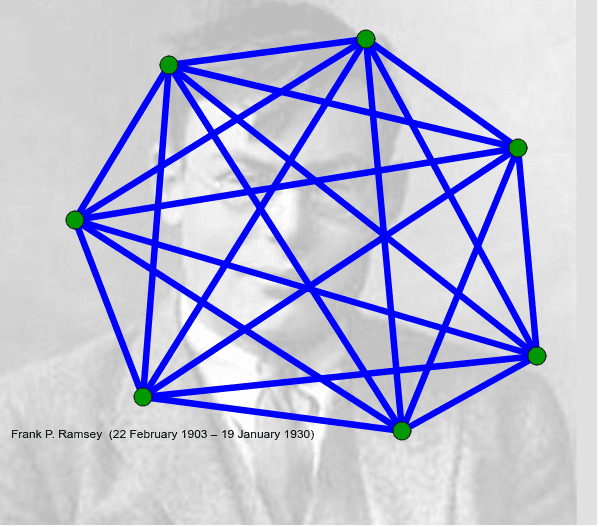
This example demonstrates the fundamental concepts of Ramsey theory through dynamic geometry, illustrating that any sufficiently large graph contains specific subgraphs. Key math concepts include graph theory, combinatorics, and infinite reasoning. Construction highlights involve the Segment command and objects like test, c, A, B, C, D, E, F, G, a, b, d, e, f, g, h, i, j, k, l, m, n, p, q, r, s, t, u, w, v, ta, tb, tc, td, te, tf, tg, th, tj, ti. Suitable for high school students and math enthusiasts learning graph theory and combinatorial ideas.
GeoGebra Commands & Parameters
Segment(A, B) → aSegment(A, C) → bSegment(A, D) → dSegment(A, E) → eSegment(A, F) → fSegment(A, G) → gSegment(B, G) → hSegment(B, F) → iSegment(B, E) → jSegment(B, D) → kSegment(B, C) → lSegment(C, G) → mSegment(F, C) → nSegment(C, E) → pSegment(C, D) → qSegment(D, G) → rSegment(D, F) → sSegment(D, E) → tSegment(E, G) → uSegment(E, F) → wSegment(F, G) → vSegment(B, C) → aa
AI Drawing Prompt Reference
Draw a complete graph with seven vertices: six points evenly spaced on a circle and one point at the center. Connect the center point to each of the six outer points with straight line segments, then connect every pair of outer points with straight line segments, so that every pair of vertices is joined by an edge. Use thin solid lines for all segments, keeping the figure clear and symmetric. The result is a seven-vertex complete graph illustrating Ramsey theory concepts.
The prompt above was compiled from the original drawing commands and is for reference only.