
Radical Numbers Construction
Loading the math board and drawing, please wait…
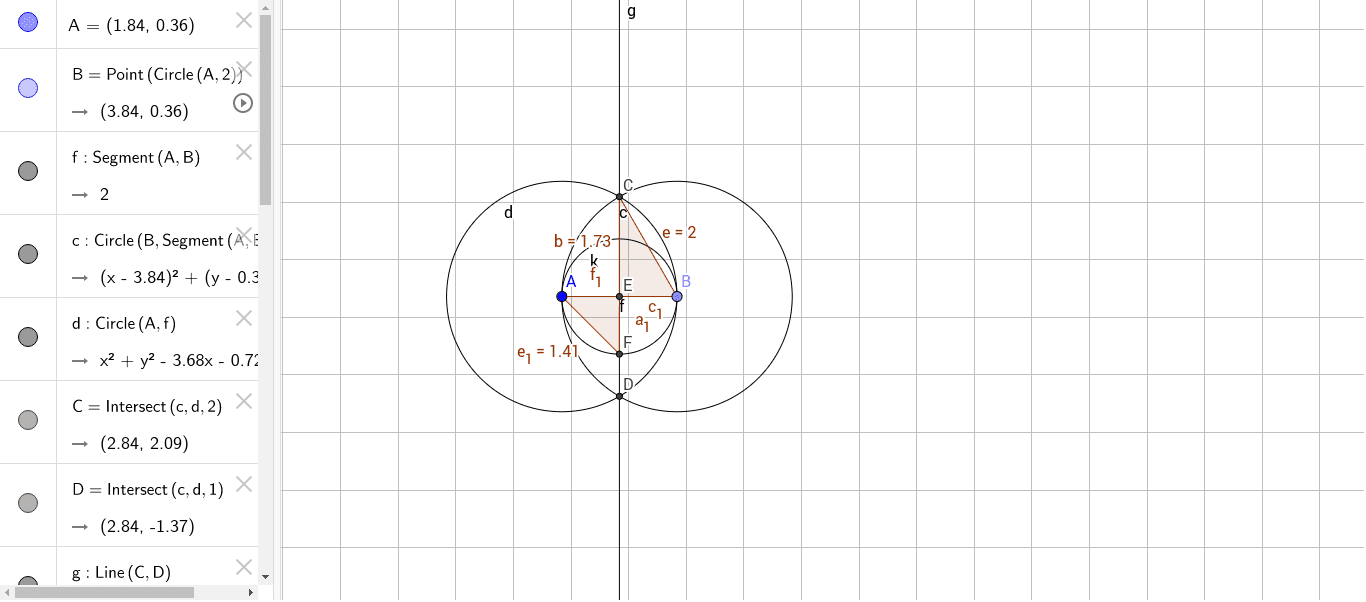
This example demonstrates how to geometrically construct radical numbers using GeoGebra. It involves core math concepts like radical numbers, circles, similar triangles, and coordinate geometry. Key GeoGebra commands and objects used in the construction include Point, Segment, Circle, Intersect, Line, Polygon, and Distance. Suitable for high school mathematics education to understand the geometric meaning and construction methods of radical numbers.
GeoGebra Commands & Parameters
Point(Circle[A, 2]) → BSegment(A, B) → fCircle(B, Segment[A, B]) → cCircle(A, f) → dIntersect(c, d, 2) → CIntersect(c, d, 1) → DLine(C, D) → gIntersect(g, f) → EPolygon(C, E, B) → poly1, b, c_1, eDistance(g, e) → aDistance(g, b) → hCircle(E, Segment[E, A]) → kIntersect(k, g, 2) → FPolygon(A, F, E) → poly2, e_1, a_1, f_1
AI Drawing Prompt Reference
Draw a geometric construction to demonstrate how radical numbers can be constructed using circles and similar triangles. Start by drawing a circle and marking a point on it. Connect the two points to form a line segment. Draw another circle with the same radius. Then draw a third circle and let the two circles intersect at two points. Connect these points and let the line intersect the initial segment. Form a triangle with these intersections. Next, draw a circle centered at one of the intersection points and let it intersect the segment at another point. Connect these two points to form another triangle, illustrating the geometric meaning of radical numbers.
The prompt above was compiled from the original drawing commands and is for reference only.