
Radian Sense Practice: Using Angle and Scaling to Build Intuition
Loading the math board and drawing, please wait…
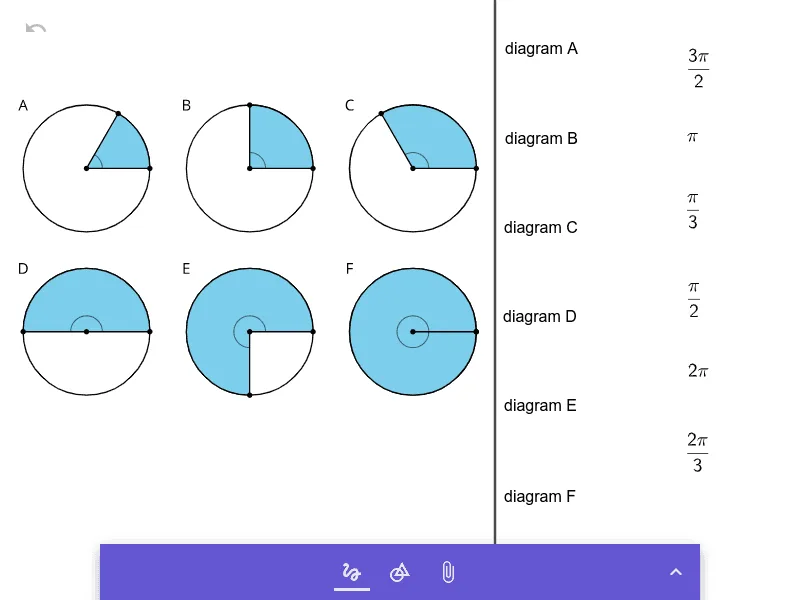
This example demonstrates how to build intuitive understanding of radians by relating a circle’s arc length to the corresponding angle. The key ideas are the radian definition (angle measured by the length of the intercepted arc relative to the radius), basic circle geometry, and how proportional relationships are preserved under geometric transformations such as dilation (scaling). In typical GeoGebra construction, learners create circle geometry and an angle (or sector) to mark the rotation, then compare cases—often by changing radius via dilation/transform—to see that the arc length scales consistently with the radius for the same radian measure. The provided content summary does not list explicit GeoGebra commands or objects, so the construction is best described in terms of the geometric objects used: circle/arc, angle measure/sector, and transformation-based comparison. Suitable for middle school to high school students, it supports pre-trigonometry learning and helps students convert the abstract rule “1 radian equals the arc length equal to the radius” into a visual, testable understanding.
AI Drawing Prompt Reference
Draw a circle with its center, radius, and an arc. Represent the angle subtended by the arc as a sector and label the arc length and radius. Apply a scaling transformation to change the circle's radius, observing how the ratio of arc length to radius remains constant for the same angle to illustrate the concept of radians.
The prompt above was compiled from the original drawing commands and is for reference only.