
Radial Symmetry Puzzle Demonstration
Loading the math board and drawing, please wait…
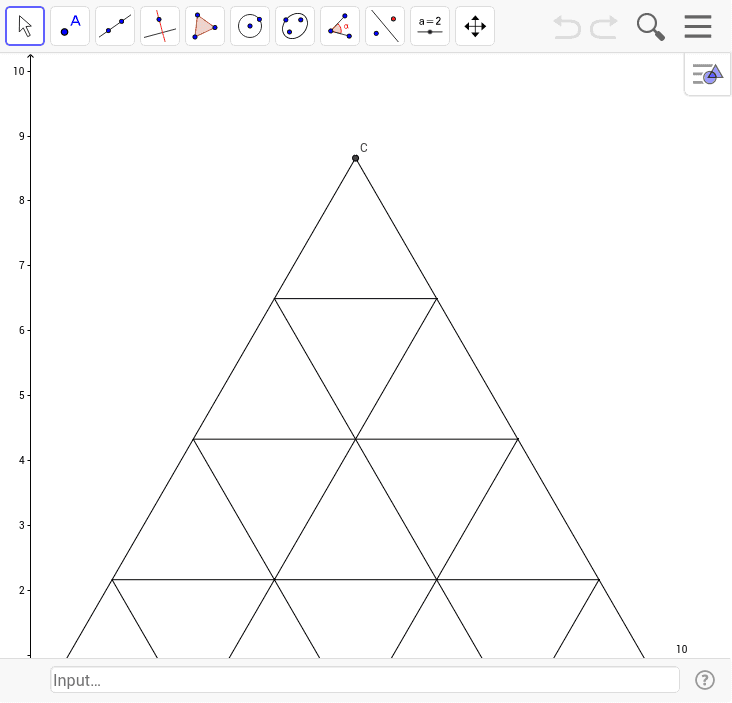
① This example demonstrates a puzzle figure based on radial symmetry, showing how polygons are arranged under rotations and reflections. ② Core mathematical concepts include symmetry transformations (rotation, reflection), linear programming/optimization, properties of parallelograms, systems of linear equations, and the hypergeometric probability distribution. ③ Construction highlights: GeoGebra commands Intersect, Point, Polygon, Midpoint, Segment create points A, B and polygon Polygon1, generating segments a, b, c and further objects C, D, E … to build the full symmetric structure. ④ Suitable for high‑school geometry and statistics courses, as well as university-level geometric modeling and optimization demonstrations.
GeoGebra Commands & Parameters
Intersect(xAxis, yAxis) → APoint(xAxis) → BPolygon(A, B, 3) → Polygon1, a, b, c, CMidpoint(A, C) → DMidpoint(B, C) → EMidpoint(B, A) → FMidpoint(D, C) → GMidpoint(E, C) → HMidpoint(F, A) → IMidpoint(F, B) → JMidpoint(E, B) → KMidpoint(D, A) → LMidpoint(D, F) → MMidpoint(E, F) → NMidpoint(E, D) → OSegment(D, F) → dSegment(E, F) → eSegment(D, E) → fSegment(O, M) → gSegment(O, N) → hSegment(N, M) → iSegment(G, O) → jSegment(H, O) → kSegment(G, H) → lSegment(L, I) → mSegment(M, I) → nSegment(L, M) → pSegment(N, J) → qSegment(K, J) → rSegment(K, N) → sSegment(C, A) → tSegment(A, B) → a_1Segment(C, B) → b_1
AI Drawing Prompt Reference
Please draw a puzzle figure based on radial symmetry, demonstrating how polygons are arranged under rotations and reflections. Start by finding the intersection of the coordinate axes as the initial point, then select another point on the x-axis. Use these two points to construct a triangle, generating corresponding edges and vertices. Next, create more segments and points by connecting the midpoints of these vertices, gradually building up the full symmetric structure. The final figure will include multiple midpoints, segments, and polygons, showcasing symmetry transformations, linear programming/optimization, properties of parallelograms, systems of linear equations, and the hypergeometric probability distribution.
The prompt above was compiled from the original drawing commands and is for reference only.