
Quadrilateral Exterior Angles Dynamic Exploration
Loading the math board and drawing, please wait…
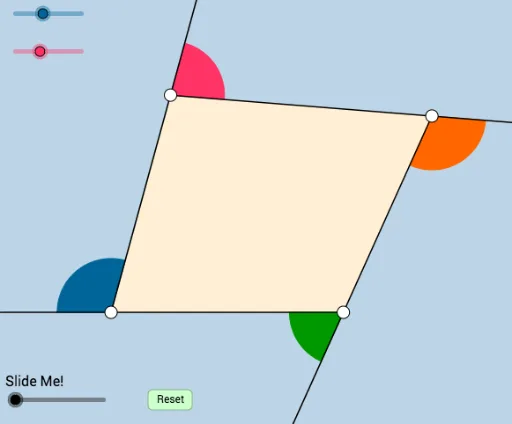
This GeoGebra example demonstrates the theorem that the sum of exterior angles of a quadrilateral equals 360 degrees. Key concepts include polygon exterior angles, angle measurement, and geometric invariance. Construction utilizes commands like Rotate, Angle, Ray, Segment, and Polygon to create a dynamic, modifiable figure. Ideal for middle school geometry students or teachers for interactive classroom demonstrations to visualize the exterior angle sum theorem.
GeoGebra Commands & Parameters
Rotate(A, (a * π / 180), B) → A'Angle(A, B, A') → αRay(B, A') → fSegment(B, A) → gPoint(f) → CAngle(B, C, A) → βRotate(B, γ, C) → B'Angle(B, C, B') → δRay(C, B') → hPoint(h) → DRay(D, A) → iSegment(A, B) → jSegment(B, C) → kSegment(C, D) → lSegment(D, A) → mMin({j, k, l, m}) → bRay(A, B) → nRay(B, C) → pCircle(B, (0.25 * b)) → cIntersect(c, n, 2) → EIntersect(c, p, 1) → FCircle(C, (0.25 * b)) → dCircle(D, (0.25 * b)) → eCircle(A, (0.25 * b)) → qIntersect(d, h, 1) → GIntersect(d, p, 2) → HIntersect(e, i, 1) → IIntersect(e, h, 2) → JIntersect(q, n, 1) → KIntersect(q, i, 2) → LCircleSector(B, F, E) → rCircleSector(C, G, H) → sCircleSector(D, I, J) → tCircleSector(A, K, L) → c_1Angle(C, D, A) → εLine(B, A) → f_1Dilate(A, If[0 < u ≤ 1, 1 - u, 0], B) → A'_1Vector(A, A'_1) → vTranslate(c_1, v) → d_1Dilate(B, If[1 < u ≤ 2, 2 - u, 0], C) → B'_1Vector(B, B'_1) → wTranslate(d_1, w) → e_1Translate(r, w) → r'Dilate(C, If[2 < u ≤ 3, 3 - u, 0], D) → C'Vector(C, C') → u_1Translate(r', u_1) → r''Translate(s, u_1) → s'Translate(e_1, u_1) → g_1Polygon(B, A, D, C) → poly1, b_1, a_1, d_2, c_2