
Quadrilateral - Can You Draw It?
Loading the math board and drawing, please wait…
In collections
Elementary Geometry
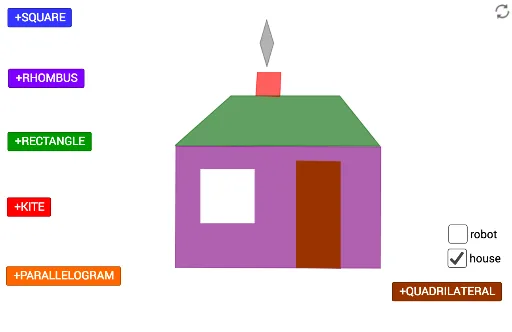
This example demonstrates how to draw quadrilaterals using GeoGebra. Key mathematical concepts include the classification of quadrilaterals (kite, parallelogram, rectangle, rhombus, square) and geometric construction. Using commands like Polygon, Point, Intersect, and Mirror, various quadrilaterals can be constructed. Suitable for middle school and above students or teachers.
GeoGebra Commands & Parameters
Polygon(A, B, 4) → poly1, f, g, h, i, C, DPolygon(A_1, B_1, 4) → poly1_1, f_1, g_1, h_1, i_1, C_1, D_1Polygon(A_2, B_2, 4) → poly1_2, f_2, g_2, h_2, i_2, C_2, D_2Polygon(A_3, B_3, 4) → poly1_3, f_3, g_3, h_3, i_3, C_3, D_3Polygon(A_4, B_4, 4) → poly1_4, f_4, g_4, h_4, i_4, C_4, D_4Polygon(A_5, B_5, 4) → poly1_5, f_5, g_5, h_5, i_5, C_5, D_5Polygon(A_6, B_6, 4) → poly1_6, f_6, g_6, h_6, i_6, C_6, D_6Polygon(A_7, B_7, 4) → poly1_7, f_7, g_7, h_7, i_7, C_7, D_7Point(CircleArc[E, Rotate[F, -1°, E], Rotate[F, -179°, E]]) → GIntersect(Circle[G, E], Circle[F, E]) → H, I, ,Polygon(E, F, I, G) → q1, e, f_8, i_8, g_8Point(CircleArc[E_1, Rotate[F_1, -1°, E_1], Rotate[F_1, -179°, E_1]]) → G_1Intersect(Circle[G_1, E_1], Circle[F_1, E_1]) → H_1, I_1, ,Polygon(E_1, F_1, I_1, G_1) → q1_1, e_1, f_9, i_9, g_9Point(CircleArc[E_2, Rotate[F_2, -1°, E_2], Rotate[F_2, -179°, E_2]]) → G_2Intersect(Circle[G_2, E_2], Circle[F_2, E_2]) → H_2, I_2, ,Polygon(E_2, F_2, I_2, G_2) → q1_2, e_2, f_{10}, i_{10}, g_{10}Point(CircleArc[E_3, Rotate[F_3, -1°, E_3], Rotate[F_3, -179°, E_3]]) → G_3Intersect(Circle[G_3, E_3], Circle[F_3, E_3]) → H_3, I_3, ,Polygon(E_3, F_3, I_3, G_3) → q1_3, e_3, f_{11}, i_{11}, g_{11}Point(CircleArc[E_4, Rotate[F_4, -1°, E_4], Rotate[F_4, -179°, E_4]]) → G_4Intersect(Circle[G_4, E_4], Circle[F_4, E_4]) → H_4, I_4, ,Polygon(E_4, F_4, I_4, G_4) → q1_4, e_4, f_{12}, i_{12}, g_{12}Point(CircleArc[E_5, Rotate[F_5, -1°, E_5], Rotate[F_5, -179°, E_5]]) → G_5Intersect(Circle[G_5, E_5], Circle[F_5, E_5]) → H_5, I_5, ,Polygon(E_5, F_5, I_5, G_5) → q1_5, e_5, f_{13}, i_{13}, g_{13}Point(CircleArc[E_6, Rotate[F_6, -1°, E_6], Rotate[F_6, -179°, E_6]]) → G_6Intersect(Circle[G_6, E_6], Circle[F_6, E_6]) → H_6, I_6, ,Polygon(E_6, F_6, I_6, G_6) → q1_6, e_6, f_{14}, i_{14}, g_{14}Point(CircleArc[E_7, Rotate[F_7, -1°, E_7], Rotate[F_7, -179°, E_7]]) → G_7Intersect(Circle[G_7, E_7], Circle[F_7, E_7]) → H_7, I_7, ,Polygon(E_7, F_7, I_7, G_7) → q1_7, e_7, f_{15}, i_{15}, g_{15}Point(OrthogonalLine[J, Line[J, K]]) → MPolygon(J, K, N, M) → q2, j, k, n, mPoint(OrthogonalLine[J_1, Line[J_1, K_1]]) → M_1Polygon(J_1, K_1, N_1, M_1) → q2_1, j_1, k_1, n_1, m_1Point(OrthogonalLine[J_2, Line[J_2, K_2]]) → M_2Polygon(J_2, K_2, N_2, M_2) → q2_2, j_2, k_2, n_2, m_2Point(OrthogonalLine[J_3, Line[J_3, K_3]]) → M_3Polygon(J_3, K_3, N_3, M_3) → q2_3, j_3, k_3, n_3, m_3Mirror(Q, Line[O, P]) → Q'Polygon(O, Q, P, Q') → q3, o, q, p, q'Mirror(Q_1, Line[O_1, P_1]) → Q'_1Polygon(O_1, Q_1, P_1, Q'_1) → q3_1, o_1, q_1, p_1, q'_1Mirror(Q_2, Line[O_2, P_2]) → Q'_2Polygon(O_2, Q_2, P_2, Q'_2) → q3_2, o_2, q_2, p_2, q'_2Mirror(Q_3, Line[O_3, P_3]) → Q'_3Polygon(O_3, Q_3, P_3, Q'_3) → q3_3, o_3, q_3, p_3, q'_3Polygon(S, U, T, R) → q4, s, u, t, rPolygon(S_1, U_1, T_1, R_1) → q4_1, s_1, u_1, t_1, r_1Polygon(S_2, U_2, T_2, R_2) → q4_2, s_2, u_2, t_2, r_2Polygon(S_3, U_3, T_3, R_3) → q4_3, s_3, u_3, t_3, r_3Point(Ray[Z, Z + W - V]) → L_1Polygon(V, W, L_1, Z) → q5, v, w, l_1, z_1Point(Ray[Z_1, Z_1 + W_1 - V_1]) → L_2Polygon(V_1, W_1, L_2, Z_1) → q5_1, v_1, w_1, l_2, z_2Point(Ray[Z_2, Z_2 + W_2 - V_2]) → L_3Polygon(V_2, W_2, L_3, Z_2) → q5_2, v_2, w_2, l_3, z_3Point(Ray[Z_3, Z_3 + W_3 - V_3]) → L_4Polygon(V_3, W_3, L_4, Z_3) → q5_3, v_3, w_3, l_4, z_4Polygon(J_4, K_4, M_4, N_4) → q6, j_4, k_4, m_4, n_4Polygon(J_5, K_5, M_5, N_5) → q6_1, j_5, k_5, m_5, n_5Polygon(J_6, K_6, M_6, N_6) → q6_2, j_6, k_6, m_6, n_6Polygon(J_7, K_7, M_7, N_7) → q6_3, j_7, k_7, m_7, n_7
AI Drawing Prompt Reference
Draw a heptagon, then draw a 1° arc at each vertex, find the intersection points of these arcs, and connect these points to form a new polygon. Next, draw a rectangle, then draw a perpendicular line on one of its diagonals, find the intersection points of this line with the rectangle's sides, and connect these points to form another new polygon. Finally, mirror one of the polygons over another line to form a mirrored polygon.
The prompt above was compiled from the original drawing commands and is for reference only.