
Quadrilateral Area and Median Line Demonstration
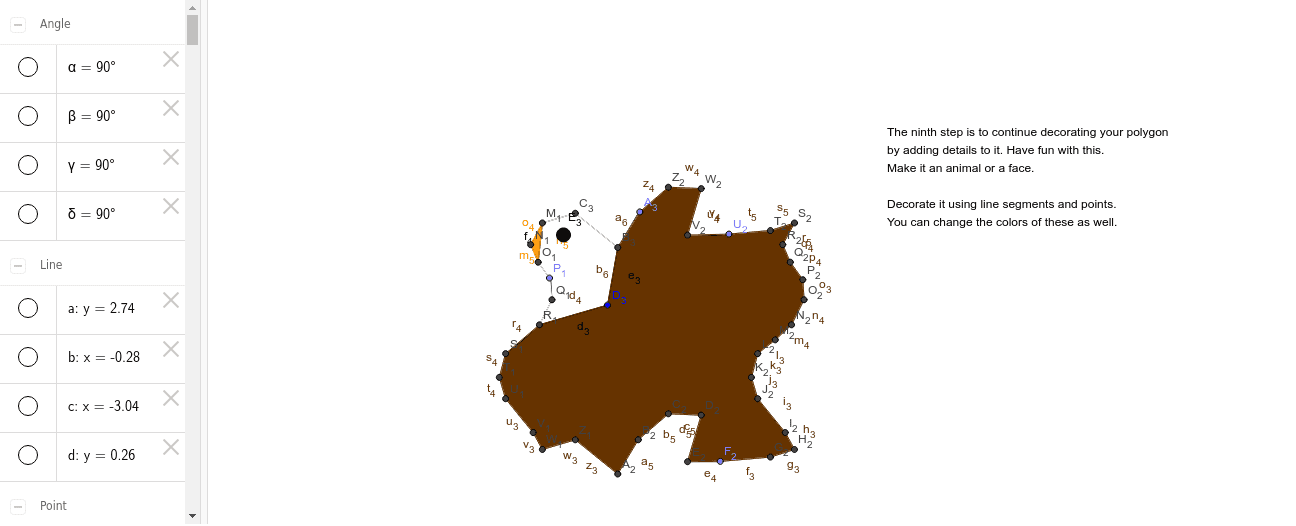
Loading the math board and drawing, please wait…
In collections
Phebe Tanner Translation Tessallation
This example demonstrates how to dynamically visualize the area of a quadrilateral and the properties of its median line. It involves core mathematical concepts such as quadrilaterals, area calculation, median line theorem, and vector operations. The construction uses GeoGebra commands and objects like Line, OrthogonalLine, Point, Intersect, Segment, Angle, Vector, Translate, Polygon. Suitable for high school mathematics teaching to understand quadrilateral geometric properties and vector applications.
GeoGebra Commands & Parameters
Line(A, B) → aOrthogonalLine(B, a) → bOrthogonalLine(A, a) → cPoint(b) → COrthogonalLine(C, c) → dIntersect(c, d) → DSegment(D, C) → eSegment(C, B) → fSegment(B, A) → gSegment(A, D) → hAngle(A, B, C) → αAngle(C, D, A) → βAngle(D, A, B) → γAngle(B, C, D) → δSegment(D, E) → iSegment(E, F) → jSegment(F, G) → kSegment(G, H) → lSegment(H, I) → mSegment(I, J) → nSegment(J, K) → pSegment(K, L) → qSegment(L, M) → rSegment(M, C) → sVector(C, B) → uTranslate(D, u) → D'Translate(E, u) → E'Segment(D', E') → i'Translate(E, u) → E'_1Translate(F, u) → F'Segment(E'_1, F') → j'Translate(F, u) → F'_1Translate(G, u) → G'Segment(F'_1, G') → k'Translate(G, u) → G'_1Translate(H, u) → H'Segment(G'_1, H') → l'Translate(H, u) → H'_1Translate(I, u) → I'Segment(H'_1, I') → m'Translate(I, u) → I'_1Translate(J, u) → J'Segment(I'_1, J') → n'Translate(J, u) → J'_1Translate(K, u) → K'Segment(J'_1, K') → p'Translate(K, u) → K'_1Translate(L, u) → L'Segment(K'_1, L') → q'Translate(L, u) → L'_1Translate(M, u) → M'Segment(L'_1, M') → r'Translate(M, u) → M'_1Translate(C, u) → C'Segment(M'_1, C') → s'Segment(D, N) → tSegment(N, O) → a_1Segment(O, P) → b_1Segment(P, Q) → c_1Segment(Q, R) → d_1Segment(R, S) → e_1Segment(S, T) → f_1Segment(T, U) → g_1Segment(U, V) → h_1Segment(V, W) → i_1Segment(W, Z) → j_1Segment(Z, A) → k_1Vector(A, B) → vTranslate(D, v) → D'_1Translate(N, v) → N'Segment(D'_1, N') → t'Translate(N, v) → N'_1Translate(O, v) → O'Segment(N'_1, O') → l_1Translate(O, v) → O'_1Translate(P, v) → P'Segment(O'_1, P') → m_1Translate(P, v) → P'_1Translate(Q, v) → Q'Segment(P'_1, Q') → n_1Translate(Q, v) → Q'_1Translate(R, v) → R'Segment(Q'_1, R') → p_1Translate(R, v) → R'_1Translate(S, v) → S'Segment(R'_1, S') → q_1Translate(S, v) → S'_1Translate(T, v) → T'Segment(S'_1, T') → r_1Translate(T, v) → T'_1Translate(U, v) → U'Segment(T'_1, U') → s_1Translate(U, v) → U'_1Translate(V, v) → V'Segment(U'_1, V') → t_1Translate(V, v) → V'_1Translate(W, v) → W'Segment(V'_1, W') → a_2Translate(W, v) → W'_1Translate(Z, v) → Z'Segment(W'_1, Z') → b_2Translate(Z, v) → Z'_1Translate(A, v) → A'Segment(Z'_1, A') → c_2Translate(D', v) → D''Intersect(j_1, k_1) → A_1Point(i_1) → B_1Intersect(h_1, i_1) → C_1Intersect(g_1, h_1) → D_1Intersect(f_1, g_1) → E_1Point(e_1) → F_1Intersect(d_1, e_1) → G_1Intersect(c_1, d_1) → H_1Intersect(b_1, c_1) → I_1Intersect(t, a_1) → J_1Intersect(i, t) → K_1Intersect(i, j) → L_1Intersect(i', k_1) → M_1Intersect(j_1, k_1) → N_1Intersect(i_1, j_1) → O_1Point(i_1) → P_1Intersect(g_1, h_1) → Q_1Intersect(f_1, g_1) → R_1Intersect(d_1, e_1) → S_1Intersect(c_1, d_1) → T_1Intersect(b_1, c_1) → U_1Intersect(t, a_1) → V_1Intersect(i, t) → W_1Intersect(i, j) → Z_1Intersect(j, k) → A_2Intersect(k, l) → B_2Intersect(l, m) → C_2Intersect(m, n) → D_2Intersect(n, p) → E_2Point(q) → F_2Intersect(r, s) → G_2Intersect(s, t') → H_2Intersect(t', l_1) → I_2Intersect(m_1, n_1) → J_2Intersect(n_1, p_1) → K_2Intersect(p_1, q_1) → L_2Intersect(q_1, r_1) → M_2Intersect(r_1, s_1) → N_2Intersect(s_1, t_1) → O_2Intersect(t_1, a_2) → P_2Intersect(a_2, b_2) → Q_2Intersect(b_2, c_2) → R_2Intersect(s', c_2) → S_2Intersect(r', s') → T_2Point(q') → U_2Intersect(n', p') → V_2Intersect(m', n') → W_2Intersect(l', m') → Z_2Point(l') → A_3Intersect(j', k') → B_3Intersect(i', j') → C_3Polygon(M_1, N_1, W_1, Z_1, A_2, B_2, C_2, D_2, E_2, F_2, G_2, H_2, O_1, I_2, J_2, K_2, L_2, M_2, N_2, O_2, P_2, Q_2, R_2, P_1, S_2, T_2, U_2, V_2, W_2, Z_2, A_3, B_3, C_3, Q_1, R_1, S_1, T_1, U_1, V_1) → poly1, m_2, v_1, w_1, z_1, a_3, b_3, c_3, d_2, e_2, f_2, g_2, n_2, h_2, i_2, j_2, k_2, l_2, m_3, n_3, o_2, p_3, q_3, o_1, r_3, s_3, t_3, u_2, v_2, w_2, z_2, a_4, b_4, c_4, p_2, q_2, r_2, s_2, t_2, u_1Segment(R_1, D_3) → d_3Segment(D_3, B_3) → e_3Polygon(D_3, R_1, C_2, D_2, E_2, F_2, G_2, H_2, I_2, J_2, K_2, L_2, S_1, M_2, N_2, O_2, P_2, Q_2, R_2, S_2, T_2, U_2, V_2, T_1, W_2, Z_2, A_3, B_3, U_1, V_1, W_1, Z_1, A_2, B_2) → poly2, d_4, b_5, c_5, d_5, e_4, f_3, g_3, h_3, i_3, j_3, k_3, r_4, l_3, m_4, n_4, o_3, p_4, q_4, r_5, s_5, t_5, u_4, s_4, v_4, w_4, z_4, a_6, b_6, t_4, u_3, v_3, w_3, z_3, a_5Segment(M_1, O_1) → f_4Polygon(M_1, N_1, O_1) → poly3, o_4, m_5, n_5
AI Drawing Prompt Reference
Draw a quadrilateral ABCD, connect its diagonals AC and BD to find their midpoints E and F. Then, draw quadrilateral EFGH where E, F, G, and H are the midpoints of AB, BC, CD, and DA respectively. Next, draw the diagonals EG and FH of quadrilateral EFGH and their midpoints I and J. Finally, connect I and J to form segment IJ.
The prompt above was compiled from the original drawing commands and is for reference only.