
Quadratic Function Graphs in Different Forms
Loading the math board and drawing, please wait…
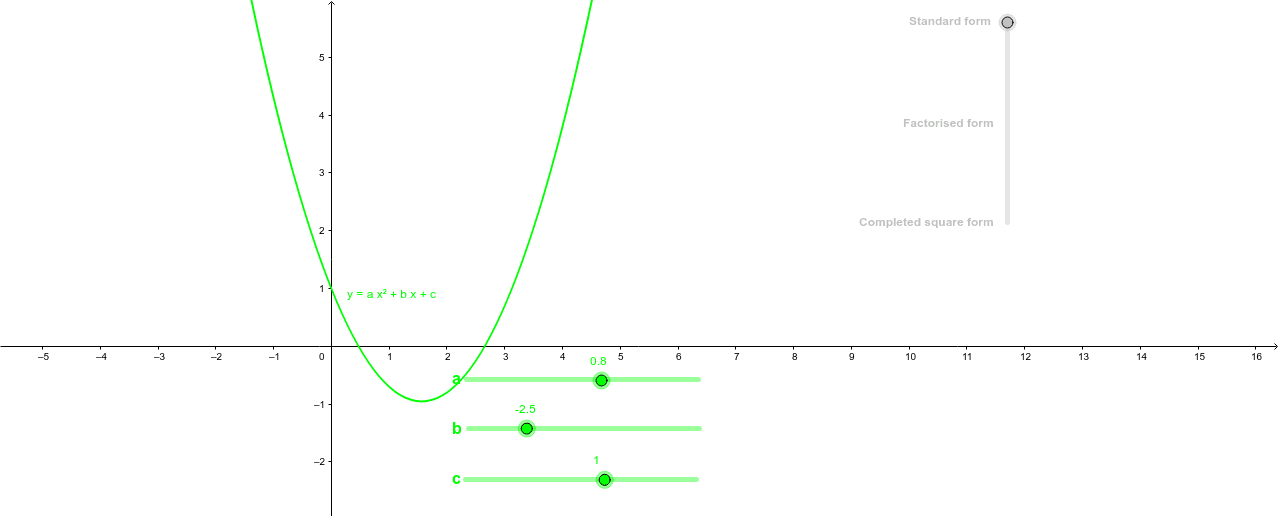
This example demonstrates the graphical characteristics and transformation relationships of quadratic functions in different algebraic forms. The core mathematical concepts include three equivalent representations of quadratic functions: vertex form, standard form (general form), and factored form, as well as properties like parabola opening direction, vertex coordinates, and axis of symmetry. Based on the construction summary, parameters a, b, c, d, e are used to control function coefficients, f and g define functions in different forms, and text labels (texte1-texte12) annotate expressions and parameter meanings. Suitable for middle school to high school mathematics teaching, useful for explaining quadratic function transformations and the relationship between coefficients and graphs, also serves as an interactive tool for students to explore quadratic function properties independently.
GeoGebra Commands & Parameters
Numeric a(0.8)Numeric b(-2.5)Numeric c(1.0)y = (a * x^(2)) + (b * x) + cNumeric e(2.0)Numeric aa(0.4)Numeric aaa(0.2)Numeric m(-0.8)Numeric n(2.0)Numeric r(0.9)Numeric s(1.9)y = ((aa * (x - m)) * (x - n))y = (aaa * (x - r)^(2)) + s