
Quadratic Function Graph and Quadrilateral Geometry Exploration
Loading the math board and drawing, please wait…
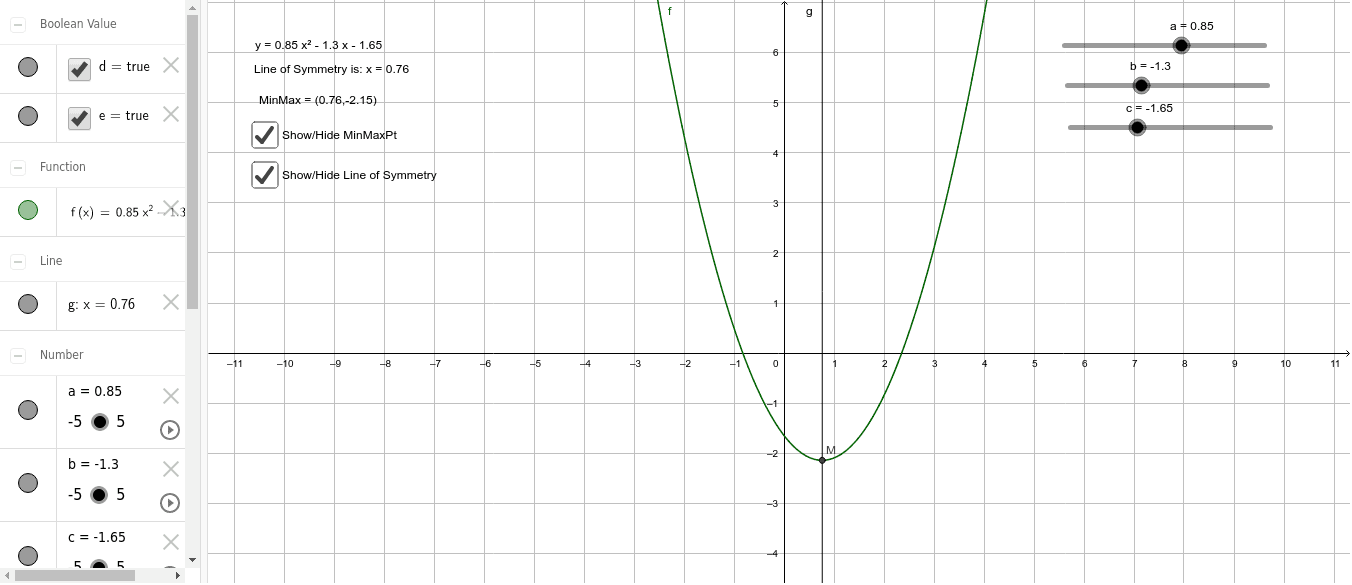
This example demonstrates the dynamic relationship between a quadratic function graph and a general quadrilateral, linking points on the function curve with quadrilateral vertices and diagonals to visualize interactions between algebraic functions and geometric shapes. Core mathematical concepts include the standard form of quadratic functions, coordinates of points on the graph, vertices and diagonals of a general quadrilateral, and the correspondence between function values and geometric quantities such as lengths or areas. Construction highlights: from the summary, objects a, b, c serve as coefficients of the quadratic, f is the function expression, x1 and y1 are coordinates of a point on the graph, M is a moving point, g is an auxiliary line or curve, text1, text2, text3 are text labels, and d, e are segment or distance objects. These are linked via GeoGebra's algebraic-geometric binding to allow dynamic parameter adjustment and observation of changes. Suitable for high school students studying quadratic functions and plane geometry integration, and for teachers demonstrating the visual connection between functions and shapes in classroom settings.
GeoGebra Commands & Parameters
Numeric a(0.85)Numeric b(-1.3)Numeric c(-1.65)f(x) = (a * x^(2)) + (b * x) + c((-b)) / ((2 * a))f(x1)(x1, y1)x = x1Boolean d(true)Boolean e(true)