
Quadratic Expressions to Factored Form (Part 3): Algebra Rewrite Practice
Loading the math board and drawing, please wait…
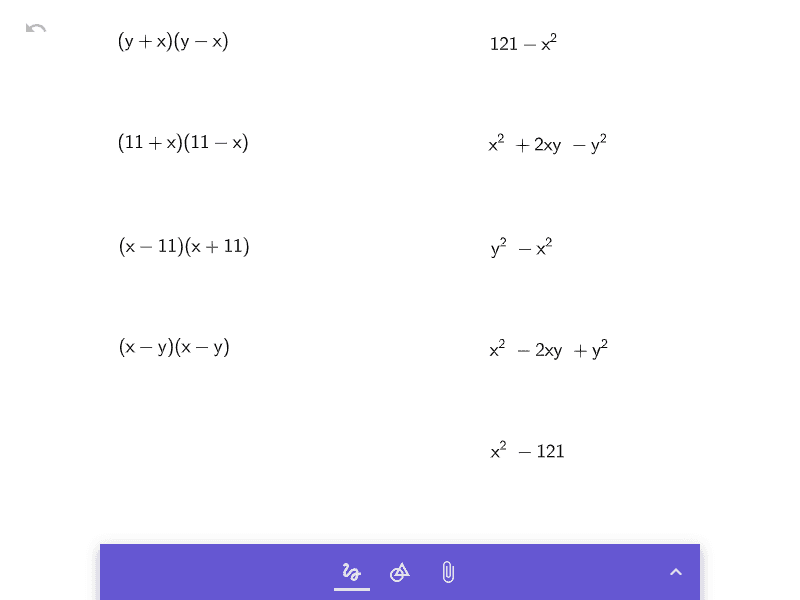
This example demonstrates how to rewrite a quadratic algebraic expression in factored (multiplicative) form. The goal is to make roots/zeros and the related behavior of the corresponding parabola easier to see and verify. Key math concepts include factoring of quadratic polynomials, algebraic equivalence via expansion/rearrangement (e.g., rewriting ax^2+bx+c into (px+q)(rx+s)), and the relationship between factored form and zeros. Construction-wise, the provided GeoGebra “construction summary” is empty, indicating the activity is primarily symbolic manipulation: entering the original quadratic expression and transforming it into an equivalent factored product; optionally, one can cross-check by plotting the corresponding quadratic function in GeoGebra. Suitable for middle/high school algebra practice, especially for students reviewing factoring and preparing for quadratic function zero/root analysis.
AI Drawing Prompt Reference
Draw a coordinate plane with an upward-opening parabola intersecting the x-axis at two distinct points, representing two real roots. Beside or below the parabola, display a quadratic expression in its original form, such as x squared plus linear and constant terms, and its factored form as a product of two linear factors. Connect the two algebraic forms with an arrow or equals sign to show equivalence. Optionally, draw a dashed vertical line for the axis of symmetry and highlight the two root positions on the x-axis. The layout should clearly illustrate the correspondence between the algebraic expressions and the graph's zeros.
The prompt above was compiled from the original drawing commands and is for reference only.