
Pythagorean Theorem Rotation Proof
Loading the math board and drawing, please wait…
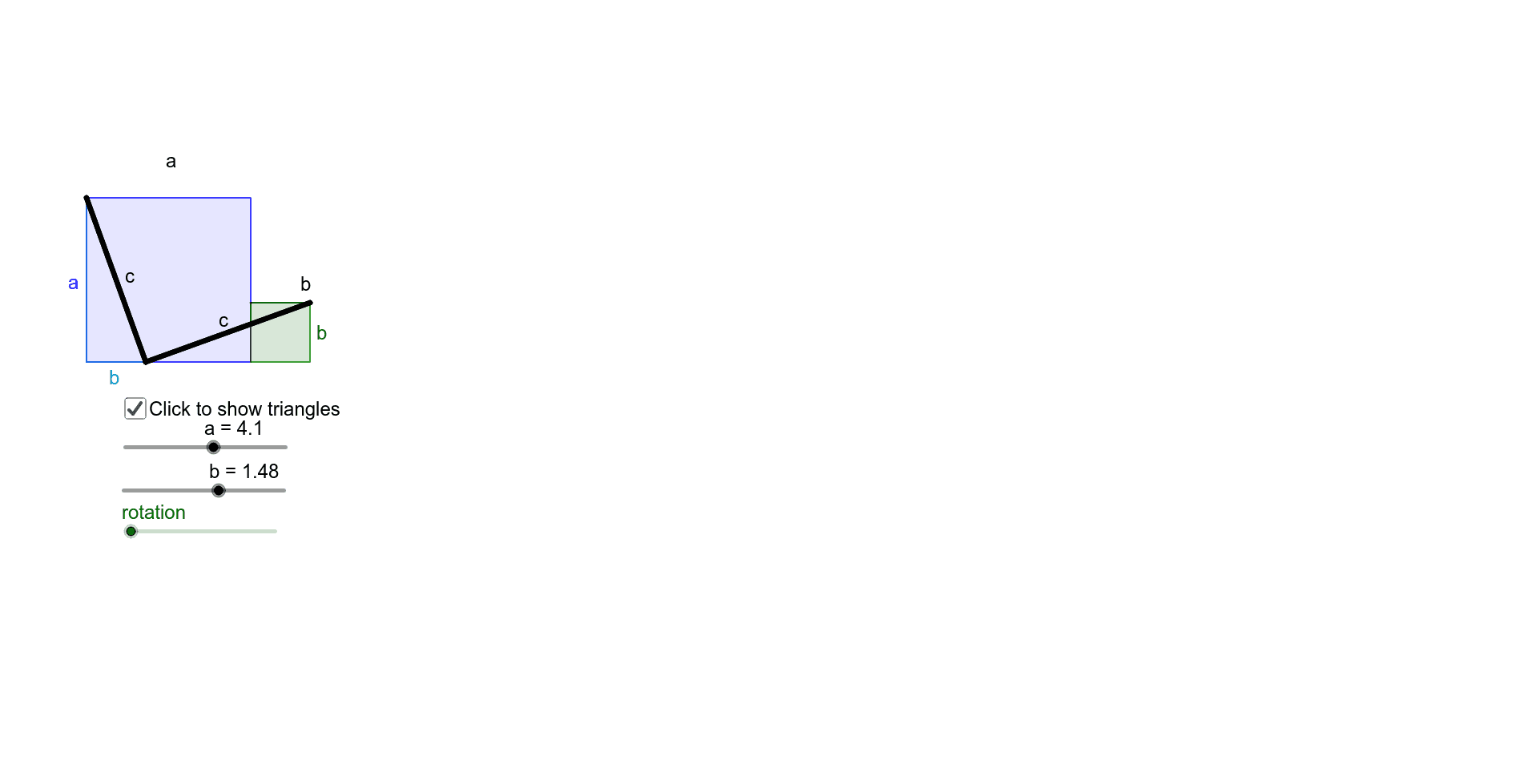
This example demonstrates the proof of the Pythagorean Theorem using rotations. It involves core concepts like transformations, congruent triangles, and area relationships. Constructed with GeoGebra commands such as Intersect, Circle, Polygon, Segment, Rotate, and Point. Suitable for middle school and above students to understand geometric proofs and transformations.
GeoGebra Commands & Parameters
Intersect(xAxis, yAxis) → ACircle(A, a) → cIntersect(c, xAxis, 2) → BCircle(B, b) → dIntersect(d, xAxis, 2) → CPolygon(A, B, 4) → poly1, e, f, g, h, D, EPolygon(B, C, 4) → poly2, i, j, k, l, F, GCircle(A, b) → pIntersect(p, e, 1) → HSegment(E, H) → mSegment(H, F) → nPolygon(E, H, A) → poly3, a_1, e_1, h_1Polygon(H, F, C) → poly4, c_1, h_2, f_1Rotate(E, rotation, E) → E'Rotate(H, rotation, E) → H'Rotate(A, rotation, E) → A'Polygon(E', H', A') → poly3', a', e', h'Rotate(F, rotation, F) → F'Rotate(E, (3 * rotation), E) → E'_1Rotate(H, (3 * rotation), F) → H'_2Rotate(F, (3 * rotation), F) → F'_1Rotate(C, (3 * rotation), F) → C'_1Polygon(H'_2, F'_1, C'_1) → poly4'_1, c'_1, h'_2, f'_1Point(k) → IIntersect(f, c_1) → JSegment(I, J) → qIntersect(k, c_1) → KPolygon(J, I, K) → poly5, k_1, j_1, i_1Intersect(g, a_1) → LIntersect(g, e') → MPolygon(L, H, J, M) → poly6, l_1, h_3, j_2, m_1Intersect(f, l) → NIntersect(f, l) → OPolygon(L, H, K, H') → poly7, l_2, h_4, k_2, h'_1
AI Drawing Prompt Reference
Draw a right triangle with two circles centered at the right angle vertex, intersecting the x-axis at two points. Then draw circles centered at these points, intersecting the x-axis at two more points. Connect these points to form several triangles and quadrilaterals. Rotate one triangle and compare the areas to demonstrate the Pythagorean theorem.
The prompt above was compiled from the original drawing commands and is for reference only.