
Pythagorean Theorem Proof Without Words by Steve Phelps
Loading the math board and drawing, please wait…
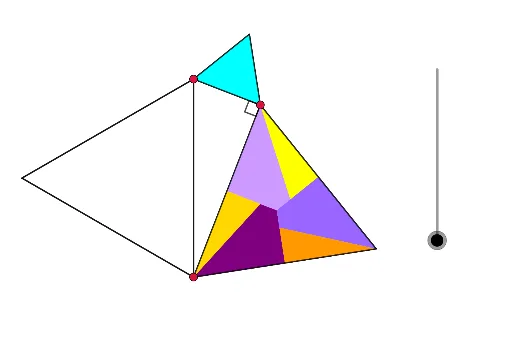
This example demonstrates the Pythagorean Theorem through geometric figures. It involves the core mathematical concepts of triangles and circles. By constructing the midpoints, semicircles, and lines of a right triangle, it shows that the area of the semicircle on the hypotenuse is equal to the sum of the areas of the semicircles on the other two sides. Commands used include Point, Polygon, Semicircle, Midpoint, Centroid, LineBisector, Mirror, Line, Intersect, Rotate, Angle, If, OrthogonalLine. Suitable for middle school and above students to learn geometric proofs.
GeoGebra Commands & Parameters
Point(yAxis) → APoint(yAxis) → BPolygon(B, A, 3) → poly3, l, m, n, FSemicircle(A, B) → cPoint(c) → CPolygon(C, B, 3) → poly2, i, j, k, EMidpoint(j) → KCentroid(poly2) → HLineBisector(i) → qMirror(A, i) → A'Line(B, A') → pIntersect(p, q) → GRotate(G, 120°, H) → G'Angle(G', B, G) → aaRotate(Translate[K, F - B], (-aa), F) → MPolygon(A, C, 3) → poly1, f, g, h, DRotate(G', 120°, H) → G''Midpoint(i) → IMidpoint(k) → JPolygon(H, G, B, K) → q1, h_1, g_1, b_2, k_1Polygon(H, G', E, J) → q2, h_2, g', e, j_1Polygon(H, G'', C, I) → q3, h_3, g'', c_1, i_1Angle(G, B, A) → aIf(0 < o ≤ 1, Rotate[Polygon[Translate[H, Vector[B, Dilate[B, 1 - o, F]]], Translate[G, Vector[B, Dilate[B, 1 - o, F]]], Translate[B, Vector[B, Dilate[B, 1 - o, F]]], Translate[K, Vector[B, Dilate[B, 1 - o, F]]]], ((-(o - 0)) * aa), Dilate[B, 1 - o, F]], Rotate[Polygon[Translate[H, F - B], Translate[G, F - B], Translate[B, F - B], Translate[K, F - B]], (-aa), F]) → q4If(2 < o ≤ 3, Rotate[Polygon[Translate[H, Vector[E, Dilate[E, 3 - o, B]]], Translate[G', Vector[E, Dilate[E, 3 - o, B]]], Translate[E, Vector[E, Dilate[E, 3 - o, B]]], Translate[J, Vector[E, Dilate[E, 3 - o, B]]]], ((-(o - 2)) * aa), Dilate[E, 3 - o, B]], Rotate[Polygon[Translate[H, B - E], Translate[G', B - E], Translate[E, B - E], Translate[J, B - E]], (-aa), B]) → q5If(4 < o ≤ 5, Rotate[Polygon[Translate[H, Vector[C, Dilate[C, 5 - o, A]]], Translate[G'', Vector[C, Dilate[C, 5 - o, A]]], Translate[C, Vector[C, Dilate[C, 5 - o, A]]], Translate[I, Vector[C, Dilate[C, 5 - o, A]]]], ((-(o - 4)) * aa), Dilate[C, 5 - o, A]], Rotate[Polygon[Translate[H, A - C], Translate[G'', A - C], Translate[C, A - C], Translate[I, A - C]], (-aa), A]) → q6Polygon(G, I, B) → t1, b_1, g_2, i_2Polygon(G', K, E) → t2, e_1, r, k_2Polygon(G'', J, C) → t3, c_2, s, j_2Line(B, G) → tOrthogonalLine(B, l) → dPoint(d) → LIf(6 < o ≤ 7, Rotate[Polygon[Translate[G, Vector[B, Dilate[B, 7 - o, F]]], Translate[I, Vector[B, Dilate[B, 7 - o, F]]], Translate[B, Vector[B, Dilate[B, 7 - o, F]]]], ((-(o - 6)) * b), Dilate[B, 7 - o, F]], Rotate[Polygon[Translate[G, F - B], Translate[I, F - B], Translate[B, F - B]], (-b), F]) → t4Rotate(Translate[K, F - B], (-aa), F) → NIf(8 < o ≤ 9, Rotate[Polygon[Translate[G', Vector[E, Dilate[E, 9 - o, B]]], Translate[K, Vector[E, Dilate[E, 9 - o, B]]], Translate[E, Vector[E, Dilate[E, 9 - o, B]]]], ((-(o - 8)) * b), Dilate[E, 9 - o, B]], Rotate[Polygon[Translate[G', B - E], Translate[K, B - E], Translate[E, B - E]], (-b), B]) → t5If(10 < o ≤ 11, Rotate[Polygon[Translate[G'', Vector[C, Dilate[C, 11 - o, A]]], Translate[J, Vector[C, Dilate[C, 11 - o, A]]], Translate[C, Vector[C, Dilate[C, 11 - o, A]]]], ((-(o - 10)) * b), Dilate[C, 11 - o, A]], Rotate[Polygon[Translate[G'', A - C], Translate[J, A - C], Translate[C, A - C]], (-b), A]) → t6Centroid(poly3) → OCentroid(poly1) → PPolygon(A, D, C) → t7, c_3, a_1, d_1If(12 < o ≤ 13, Rotate[Polygon[Translate[A, Vector[P, Dilate[P, 13 - o, O]]], Translate[D, Vector[P, Dilate[P, 13 - o, O]]], Translate[C, Vector[P, Dilate[P, 13 - o, O]]]], ((-(o - 12)) * b), Dilate[P, 13 - o, O]], Rotate[Polygon[Translate[A, O - P], Translate[D, O - P], Translate[C, O - P]], (-b), O]) → t8Angle(A, C, B) → α
AI Drawing Prompt Reference
Draw a right triangle with one leg on the y-axis. Construct a semicircle with the hypotenuse as diameter, and place a point on this semicircle to form the triangle. Then draw semicircles on each of the three sides, marking their centers. Inside the triangle, create three quadrilaterals whose areas correspond to the semicircles. By rotating and translating, transform the three semicircular regions into the quadrilaterals, visually proving that the area of the semicircle on the hypotenuse equals the sum of the areas on the other two sides. Add angle labels and a slider to animate the transformation.
The prompt above was compiled from the original drawing commands and is for reference only.