
Pythagorean Theorem Exploration by mcalpiho
Loading the math board and drawing, please wait…
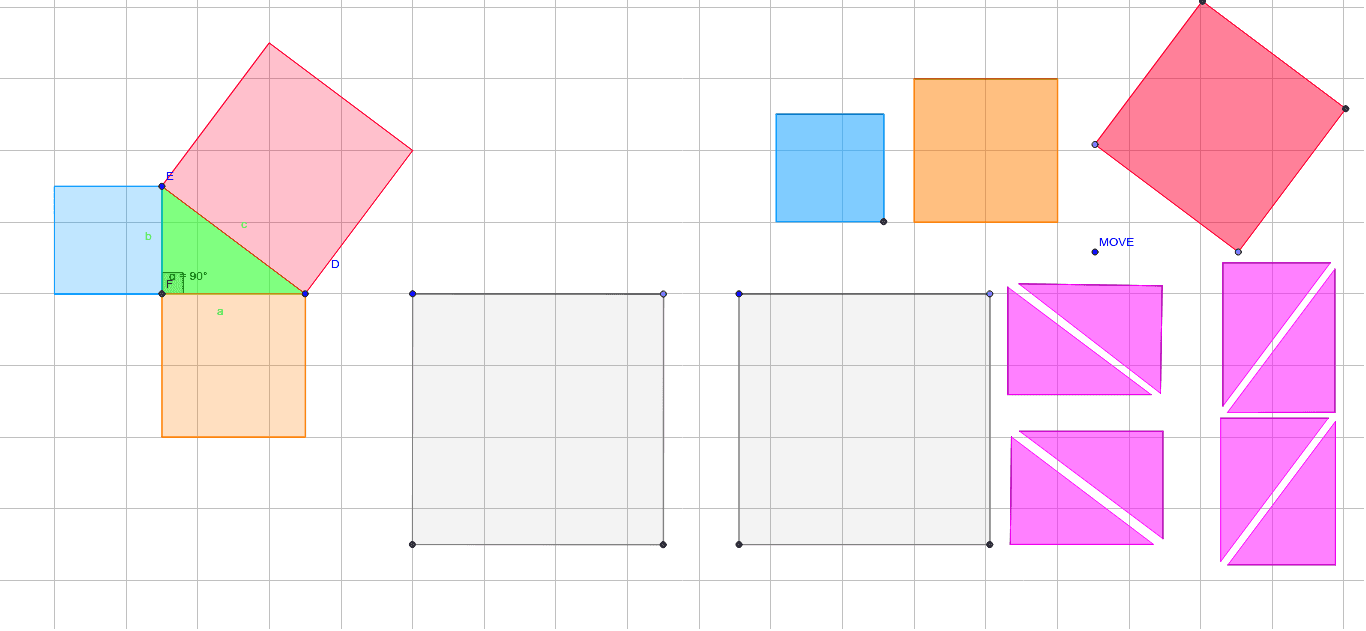
This activity demonstrates the Pythagorean Theorem by comparing the areas of squares on each side of a right triangle. Students explore the relationship between the lengths of the sides and the areas using GeoGebra commands like Line, OrthogonalLine, Intersect, Polygon, etc. Ideal for middle school and high school students learning geometry and algebra.
GeoGebra Commands & Parameters
Line(S, D) → LOrthogonalLine(R, L) → MOrthogonalLine(E, L) → NIntersect(L, N) → FPolygon(E, F, D) → poly1, b, a, cAngle(D, F, E) → αPolygon(D, F, 4) → poly2, f, g, h, i, F_1, GPolygon(F, E, 4) → poly3, j, k, l, m_2, H, IPolygon(E, D, 4) → poly4, n_2, p, q, r, J, KPoint(Circle[V, a + b]) → WSegment(V, W) → mPoint(Circle[Z, a + b]) → A_1Segment(Z, A_1) → nPolygon(A_1, Z, 4) → poly8, i_1, j_1, k_1, l_1, B_1, C_1Polygon(W, V, 4) → poly9, m_1, n_1, p_1, q_1, D_1, E_1Point(Circle[K_2, a]) → L_2Point(Circle[M_2, a]) → N_2Line(K_2, L_2) → a_4Point(Circle[K_2, b]) → P_2Line(M_2, N_2) → d_4Point(Circle[M_2, b]) → R_2Point(Circle[S_2, a]) → T_2Point(Circle[S_2, b]) → U_2Point(Circle[V_2, a]) → W_2Segment(V_2, W_2) → i_4Point(Circle[V_2, b]) → Z_2Segment(V_2, Z_2) → j_4Polygon(Z_2, V_2, W_2) → poly20, w_2, z_2, v_2Point(Circle[G_3, a]) → H_3Segment(G_3, H_3) → h_4Point(Circle[G_3, b]) → I_3Segment(G_3, I_3) → m_4Polygon(I_3, G_3, H_3) → poly21, h_5, i_5, g_5Angle(poly20) → θ, ι, κAngle(poly21) → ϕ, χ, ψPoint(Circle[A_3, a]) → B_3Segment(A_3, B_3) → s_3Rotate(B_3, 90*°, A_3) → C_3Angle(B_3, A_3, C_3) → δSegment(C_3, A_3) → t_3Point(Circle[A_3, b]) → D_3Segment(A_3, D_3) → b_4Polygon(D_3, A_3, B_3) → poly17, b_5, d_5, a_5Point(Circle[E_3, a]) → F_3Segment(E_3, F_3) → c_4Point(Circle[E_3, b]) → J_3Segment(E_3, J_3) → e_4Angle(J_3, E_3, F_3) → εPolygon(J_3, E_3, F_3) → poly18, f_4, j_5, e_5Point(Circle[K_3, a]) → L_3Segment(K_3, L_3) → g_4Point(Circle[K_3, b]) → M_3Segment(K_3, M_3) → k_4Angle(L_3, K_3, M_3) → ζPolygon(M_3, K_3, L_3) → poly19, l_4, m_5, k_5Point(Circle[N_3, a]) → O_3Segment(N_3, O_3) → n_4Point(Circle[N_3, b]) → P_3Segment(N_3, P_3) → p_4Angle(O_3, N_3, P_3) → ηPolygon(O_3, N_3, P_3) → poly22, p_5, o_3, n_5Point(Circle[A, a]) → BSegment(A, B) → dPoint(Circle[A, b]) → CSegment(A, C) → ePoint(Circle[O, a]) → PSegment(O, P) → sPoint(Circle[O, b]) → QSegment(O, Q) → tAngle(B, A, C) → βPolygon(B, C, A) → poly5, a_1, b_1, c_1Angle(P, O, Q) → γPolygon(P, O, Q) → poly6, q_2, p_2, oPoint(Circle[T, a]) → USegment(T, U) → d_1Point(Circle[G_1, b]) → H_1Segment(G_1, H_1) → e_1Polygon(U, T, 4) → poly7, g_1, h_1, r_1, s_1, K_1, L_1Polygon(H_1, G_1, 4) → poly10, t_1, a_2, b_2, c_2, M_1, N_1Point(Circle[MOVE, a]) → R_1Segment(MOVE, R_1) → h_2Rotate(R_1, 90*°, MOVE) → S_1Angle(R_1, MOVE, S_1) → λOrthogonalLine(S_1, h_2) → i_2Point(Circle[MOVE, b]) → T_1Segment(MOVE, T_1) → j_2Angle(R_1, MOVE, T_1) → μOrthogonalLine(T_1, h_2) → k_2Polygon(T_1, MOVE, R_1) → poly12, r_2, t_2, q_3Line(MOVE, R_1) → l_2Line(T_1, l_2) → d_3Polygon(T_1, R_1, 4) → poly13, s_2, a_3, b_3, c_3, V_1, W_1
AI Drawing Prompt Reference
Draw a right triangle and construct squares on each of its sides. Compare the areas of the squares to demonstrate the Pythagorean theorem. Start by drawing the right triangle, then construct squares on each side, labeling their areas. Next, draw a line from the right angle to the midpoint of the hypotenuse and show the length relationships. Finally, use rotations and reflections to further verify the geometric meaning of the Pythagorean theorem.
The prompt above was compiled from the original drawing commands and is for reference only.