
Pythagorean Theorem Dynamic Geometry Demonstration
Loading the math board and drawing, please wait…
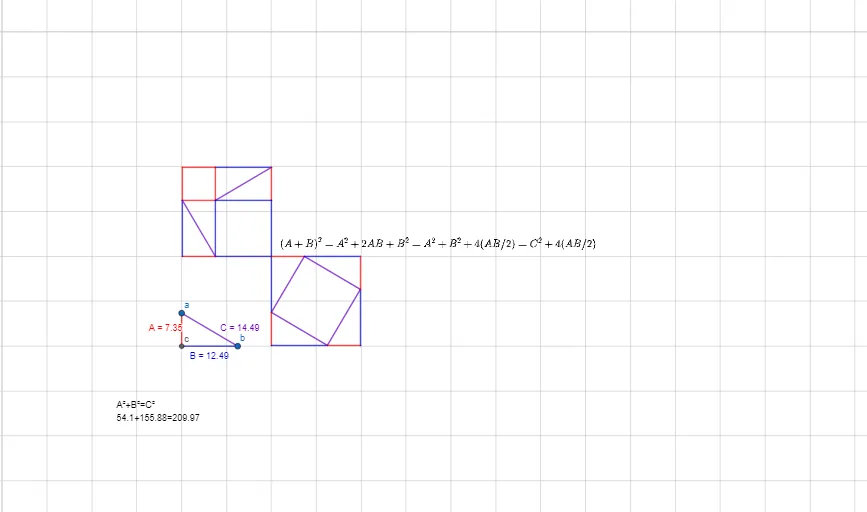
① This GeoGebra example dynamically demonstrates the Pythagorean theorem in a right triangle, showing that the sum of the areas of squares on the two legs equals the area of the square on the hypotenuse. ② Core mathematical concepts include right triangles, the Pythagorean theorem, area conservation, perpendicularity, and parallelism, along with verifying algebraic identities through geometric construction. ③ Construction highlights: uses OrthogonalLine to create perpendiculars, Point to define vertices, Segment to connect sides, and Intersect to find foot points; objects include multiple segments (a, b, c, d, e, etc.), perpendicular lines (h, k, l, m, n, p, q, r), and numerous polygon regions (S1 to S16) for area comparison. ④ Suitable for middle and high school students learning geometric theorems, and for teachers to demonstrate the proof and area relationships of the Pythagorean theorem, fostering geometric intuition and logical reasoning.
GeoGebra Commands & Parameters
OrthogonalLine((0, 0), f) → gPoint(g) → aPoint(f) → bSegment(a, b) → CIntersect(f, g) → cSegment(a, c) → ASegment(c, b) → BSegment(S5, S4) → hSegment(S4, S6) → kSegment(S6, S5) → lSegment(S6, S9) → mSegment(S9, S8) → nSegment(S8, S4) → pSegment(S4, S2) → qSegment(S2, S1) → rSegment(S2, S7) → dSegment(S7, S8) → eSegment(S8, S2) → f_1Segment(S12, S11) → g_1Segment(S11, S16) → h_1Segment(S16, S13) → i_1Segment(S13, S12) → j_1Segment(S1, S11) → l_1Segment(S11, S14) → m_1Segment(S14, S16) → n_1Segment(S16, S15) → p_1Segment(S15, S13) → q_1Segment(S5, S3) → iSegment(S3, S4) → jSegment(S3, S1) → s_{2}Segment(S12, S1) → k_1Segment(S12, S17) → r_1Segment(S17, S13) → s_1
AI Drawing Prompt Reference
Draw a right triangle ABC with point A at the origin, point B on the x-axis, and point C on the y-axis. Use the orthogonal line tool to create a line g perpendicular to AB, intersecting at point C. Connect AC and BC to form the right triangle. Then, create multiple vertical and horizontal segments to form several small squares and rectangles, which are used to demonstrate the Pythagorean theorem, i.e., the sum of the areas of the squares on the two legs equals the area of the square on the hypotenuse.
The prompt above was compiled from the original drawing commands and is for reference only.