
Pythagorean Theorem: Dynamic Area Verification
Loading the math board and drawing, please wait…
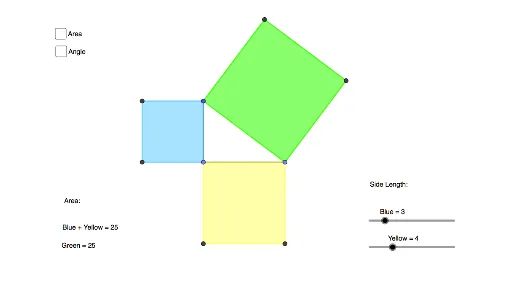
① This GeoGebra example dynamically demonstrates the Pythagorean theorem by constructing squares on the three sides of a right triangle, showing that the sum of the areas of the two smaller squares equals the area of the largest square. ② Core mathematical concepts include right triangles, square areas, area conservation, geometric proof of the Pythagorean theorem, and verifying algebraic identities through area comparison. ③ Construction details: Using GeoGebra commands such as Point, Segment, Polygon, Angle, and PointIn, the example builds a right triangle and squares on each side, marks the right angle, places interior points, and computes polygon areas with the Area command. Text objects (ans, text1, text3) display numerical area values and the verification result. The construction involves multiple polygons (poly4, poly5, poly6) and auxiliary points (J, K, L, M, N, O, P, Q, R), and includes fractions to represent area ratios. ④ This is suitable for middle school geometry lessons on the Pythagorean theorem, high school discussions of area-based proofs and algebraic identities, and for teachers creating interactive instructional materials.
GeoGebra Commands & Parameters
Point(Circle[J, Blue]) → KSegment(J, K) → a_2Point(Circle[K, Yellow]) → LSegment(K, L) → cPolygon(K, J, 4) → poly4, d, e, f_1, g_1, M, NPolygon(L, K, 4) → poly5, h_1, i_1, j_1, k_1, O, PAngle(L, K, J) → βPolygon(J, L, 4) → poly6, l_1, m_1, n_1, p_1, Q, RPointIn(poly5) → Pointpoly5PointIn(poly4) → Pointpoly4PointIn(poly6) → Pointpoly6
AI Drawing Prompt Reference
Draw a right triangle with its right angle vertex in the middle. Construct a square on each of the two legs and on the hypotenuse, all squares extending outward from the triangle. Mark the right angle with a small square symbol. Place a point inside each of the three squares. Use distinct colors for the three squares. Display the numerical area of each square, and show that the sum of the areas of the two smaller squares equals the area of the largest square. The overall layout should clearly emphasize the area relationship.
The prompt above was compiled from the original drawing commands and is for reference only.