
Pythagorean Theorem Demonstration by GaëlleJ
Loading the math board and drawing, please wait…
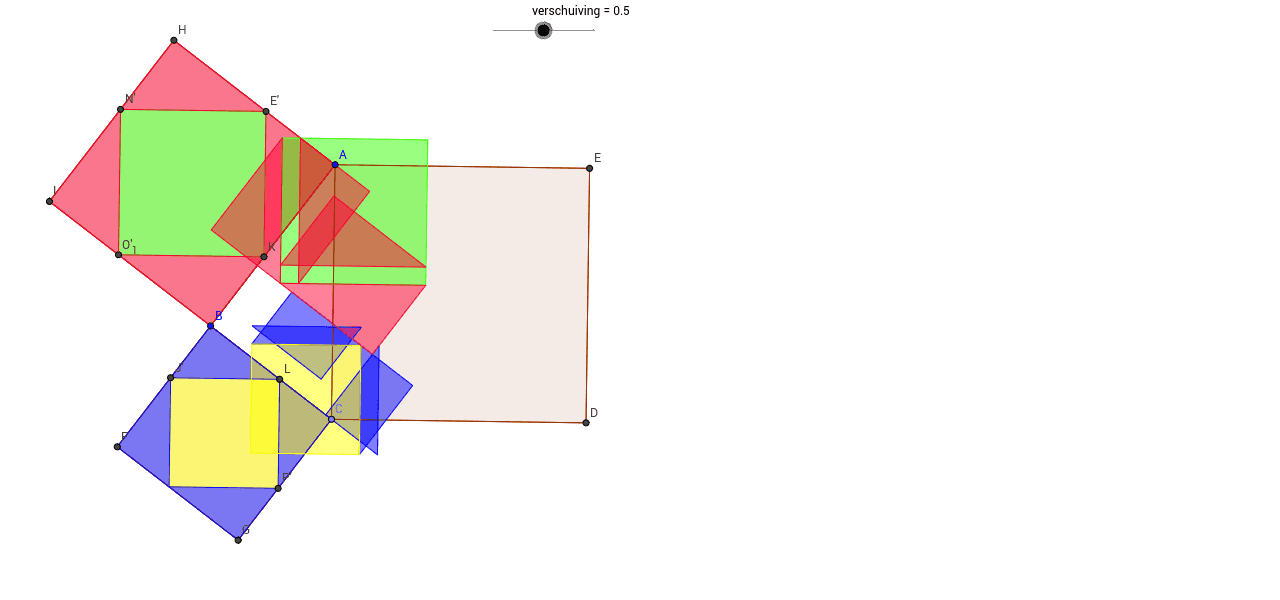
This example demonstrates the Pythagorean theorem in right-angled triangles, illustrating the relationship between the lengths of the sides. Key math concepts include the Pythagorean theorem, right triangles, vectors, and geometric transformations. The construction utilizes GeoGebra commands/objects such as Segment, OrthogonalLine, Point, Polygon, AngularBisector, Intersect, Vector, Translate, and Circle. It is suitable for middle school students and above for learning geometric constructions and theorem verification, as well as for classroom demonstrations.
GeoGebra Commands & Parameters
Segment(A, B) → aOrthogonalLine(B, a) → bPoint(b) → CSegment(B, C) → cPolygon(A, C, B) → veelhoek1, b_1, a_1, c_1Polygon(A, C, 4) → veelhoek2, a_2, c_2, d, e, D, EPolygon(C, B, 4) → veelhoek3, c_3, b_2, f, g, F, GPolygon(B, A, 4) → veelhoek4, b_3, a_3, h, i, H, IAngularBisector(a, c) → j, kIntersect(k, b_1) → JOrthogonalLine(J, c) → lOrthogonalLine(J, a) → mIntersect(m, a) → KIntersect(b, l) → LPolygon(K, J, L, B) → veelhoek5, k_1, j_1, l_1, b_4OrthogonalLine(A, a) → nIntersect(l, n) → MPolygon(A, M, J) → veelhoek6, j_2, a_4, m_1Intersect(l, e) → NPolygon(N, M, A) → veelhoek7, a_5, n_1, m_2OrthogonalLine(D, a_4) → pIntersect(l, p) → SOrthogonalLine(N, c_2) → qOrthogonalLine(J, q) → rIntersect(p, q) → OIntersect(q, c_2) → PPolygon(J, O, P, C) → veelhoek8, j_3, o, p_1, c_4Vector(O, L) → uTranslate(J, u) → J'Translate(O, u) → O'Translate(P, u) → P'Translate(C, u) → C'Polygon(J', O', P', C') → veelhoek8', j', o', p', c'Intersect(r, d) → QPolygon(N, E, Q, O) → veelhoek9, n_2, e_1, q_1, o_1Vector(Q, K) → vTranslate(N, v) → N'Translate(E, v) → E'Translate(Q, v) → Q'Translate(O, v) → O'_1Polygon(N', E', Q', O'_1) → veelhoek9', n', e', q', o'_1OrthogonalLine(Q, p) → sOrthogonalLine(P, p) → tIntersect(p, s) → RIntersect(p, t) → TPolygon(Q, R, D) → veelhoek10, d_1, q_2, r_1Polygon(P, T, O) → veelhoek11, o_2, p_2, t_1Polygon(P, T, D) → veelhoek12, d_2, p_3, t_2Polygon(R, Q, O) → veelhoek13, o_3, r_2, q_3Polygon(S, N, O) → veelhoek14, o_4, s_1, n_3Polygon(J, S, O) → veelhoek15, o_5, j_4, s_2Polygon(K, A, E') → veelhoek16, e'_1, k_2, a_6Polygon(B, K, O'_1) → veelhoek17, o'_2, b_5, k_3Polygon(E', H, N') → veelhoek18, n'_1, e'_2, h_1Polygon(N', I, O'_1) → veelhoek19, o'_3, n'_2, i_1Polygon(J', B, L) → veelhoek20, l_2, j'_1, b_6Polygon(L, C, P') → veelhoek21, p'_1, l_3, c_5Polygon(P', G, C') → veelhoek22, c'_1, p'_2, g_1Polygon(C', J', F) → veelhoek23, f_1, c'_2, j'_2Segment(E', E) → e_2Circle(E', verschuiving * Distance[E', E]) → f_2Intersect(f_2, e_2, 1) → UVector(E', U) → wTranslate(N', w) → N''Translate(E', w) → E''Translate(Q', w) → Q''Translate(O'_1, w) → VPolygon(N'', E'', Q'', V) → veelhoek9'', n'', e'', q'', v_1Segment(P', P) → g_2Circle(P', verschuiving * Distance[P', P]) → h_2Intersect(h_2, g_2, 1) → WVector(P', W) → zTranslate(L, z) → L'Translate(C, z) → C'_1Translate(P', z) → P''Polygon(L', C'_1, P'') → veelhoek21', p'', l', c'_3Segment(C', D) → i_2Circle(C', verschuiving * Distance[C', D]) → d_3Intersect(d_3, i_2, 1) → ZVector(C', Z) → u_1Translate(C', u_1) → C''Translate(J', u_1) → J''Translate(F, u_1) → F'Polygon(C'', J'', F') → veelhoek23', f', c'', j''Segment(J', J) → e_3Circle(J', verschuiving * Distance[J', J]) → f_3Intersect(f_3, e_3, 1) → A_1Vector(J', A_1) → w_1Translate(J', w_1) → J''_1Translate(B, w_1) → B'Translate(L, w_1) → L'_1Polygon(J''_1, B', L'_1) → veelhoek20', l'_1, j''_1, b'Segment(P', N) → g_3Circle(P', verschuiving * Distance[P', N]) → h_3Intersect(h_3, g_3, 1) → B_1Vector(P', B_1) → z_1Translate(P', z_1) → P''_1Translate(G, z_1) → G'Translate(C', z_1) → C''_1Polygon(P''_1, G', C''_1) → veelhoek22', c''_1, p''_1, g'Translate(J', z) → J''_2Translate(O', z) → O''Translate(P', z) → P''_2Translate(C', z) → C''_2Polygon(J''_2, O'', P''_2, C''_2) → veelhoek8'', j''_2, o'', p''_2, c''_2Segment(K, Q) → i_3Circle(K, verschuiving * Distance[Q', Q]) → r_3Intersect(q'', e'') → C_1Vector(K, Q'') → u_2Translate(B, u_2) → B'_1Translate(K, u_2) → K'Translate(O'_1, u_2) → D_1Polygon(B'_1, K', D_1) → veelhoek17', d_4, b'_1, k'Segment(H, T) → m_3Circle(H, verschuiving * Distance[H, T]) → s_3Intersect(a_2, m_1) → E_1Intersect(a_2, m_1) → F_1Intersect(a_2, m_1) → G_1Intersect(s_3, m_3, 1) → H_1Vector(H, H_1) → v_2Translate(E', v_2) → E''_1Translate(H, v_2) → H'Translate(N', v_2) → N''_1Polygon(E''_1, H', N''_1) → veelhoek18', n''_1, e''_1, h'Segment(I, S) → t_3Circle(I, verschuiving * Distance[I, S]) → e_4Intersect(e_4, t_3, 1) → I_1Vector(I, I_1) → w_2Translate(N', w_2) → N''_2Translate(I, w_2) → I'Translate(O'_1, w_2) → J_1Polygon(N''_2, I', J_1) → veelhoek19', j_5, n''_2, i'Segment(A, M) → f_4Segment(E', A) → g_4Circle(E', verschuiving * Distance[E', A]) → h_4Intersect(a_3, k_2) → K_1Intersect(a_3, k_2) → L_1Intersect(a_3, k_2) → M_1Intersect(a_3, k_2) → N_1Intersect(a_3, k_2) → O_1Intersect(h_4, a_3, 1) → P_1Vector(E', P_1) → z_2Translate(K, z_2) → K'_1Translate(A, z_2) → A'Translate(E', z_2) → E''_2Polygon(K'_1, A', E''_2) → veelhoek16', e''_2, k'_1, a'
AI Drawing Prompt Reference
Draw a right-angled triangle and label the lengths of its two legs. Demonstrate the Pythagorean theorem by constructing and rotating these sides to form various shapes. Start by drawing the right-angled triangle, then create perpendicular lines and use vectors to construct new figures. Translate and rotate these shapes to form multiple interconnected polygons, visually illustrating the relationship between the sides as described by the Pythagorean theorem.
The prompt above was compiled from the original drawing commands and is for reference only.