
Pythagorean Squares Visualization
Loading the math board and drawing, please wait…
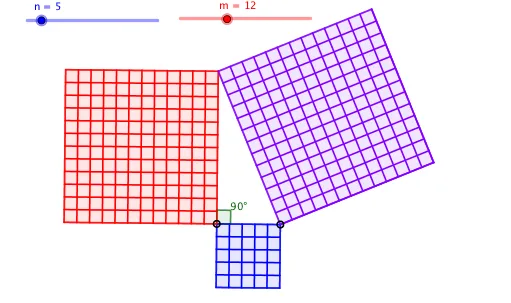
This example visually illustrates the Pythagorean theorem using square grids. It involves core math concepts like the Pythagorean theorem, area calculation, and vector operations. Constructed with GeoGebra commands such as UnitVector, OrthogonalVector, Sequence, Polygon, and Angle, it is suitable for middle school and above, helping students grasp the geometric meaning of the theorem.
GeoGebra Commands & Parameters
UnitVector(Segment[A, B]) → uOrthogonalVector(u) → vSequence(Sequence[A + (dlt * ((i * u) - (j * v))), i, 0, n - 1], j, 0, n - 1) → l1Sequence(Sequence[A + (dlt * (((-i) * u) + (j * v))), i, 0, m - 1], j, 0, m - 1) → l2UnitVector(Segment[C, B]) → wOrthogonalVector(w) → w'Sequence(Sequence[C + (dlt * ((i * w) + (j * w'))), i, 0, p - 1], j, 0, p - 1) → l3Polygon(B, A, 4) → poly1, f, g, h, i, D, EPolygon(A, C, 4) → poly2, j, k, l, q, F, GPolygon(C, B, 4) → poly3, r, s, t, a, H, ISequence(Segment[Translate[A, Vector[((i * u) * dlt)]], Translate[D, Vector[((i * u) * dlt)]]], i, 1, n - 1) → l4Sequence(Segment[Translate[B, Vector[(((-i) * v) * dlt)]], Translate[A, Vector[(((-i) * v) * dlt)]]], i, 1, n - 1) → l5Sequence(Segment[Translate[A, Vector[(((-i) * u) * dlt)]], Translate[C, Vector[(((-i) * u) * dlt)]]], i, 1, m - 1) → l6Sequence(Segment[Translate[G, Vector[((i * v) * dlt)]], Translate[A, Vector[((i * v) * dlt)]]], i, 1, m - 1) → l7Sequence(Segment[Translate[I, Vector[((i * w) * dlt)]], Translate[C, Vector[((i * w) * dlt)]]], i, 1, p) → l8Sequence(Segment[Translate[C, Vector[((i * w') * dlt)]], Translate[B, Vector[((i * w') * dlt)]]], i, 1, p) → l9Angle(B, A, C) → α
AI Drawing Prompt Reference
Draw a right triangle with vertices at the lower left, lower right, and top. Construct a square outward on each side of the triangle. Fill each square with a fine uniform grid of lines: for the square on the hypotenuse, grid lines are parallel and perpendicular to the hypotenuse; for the squares on the legs, grid lines are parallel and perpendicular to the respective leg. Mark a right angle symbol at the right-angle vertex. The overall figure illustrates the Pythagorean theorem, showing that the sum of the areas of the two smaller squares equals the area of the largest square.
The prompt above was compiled from the original drawing commands and is for reference only.