
Pythagorean Right Triangles: Exploring Integer Sides and Expected Perimeter
Loading the math board and drawing, please wait…
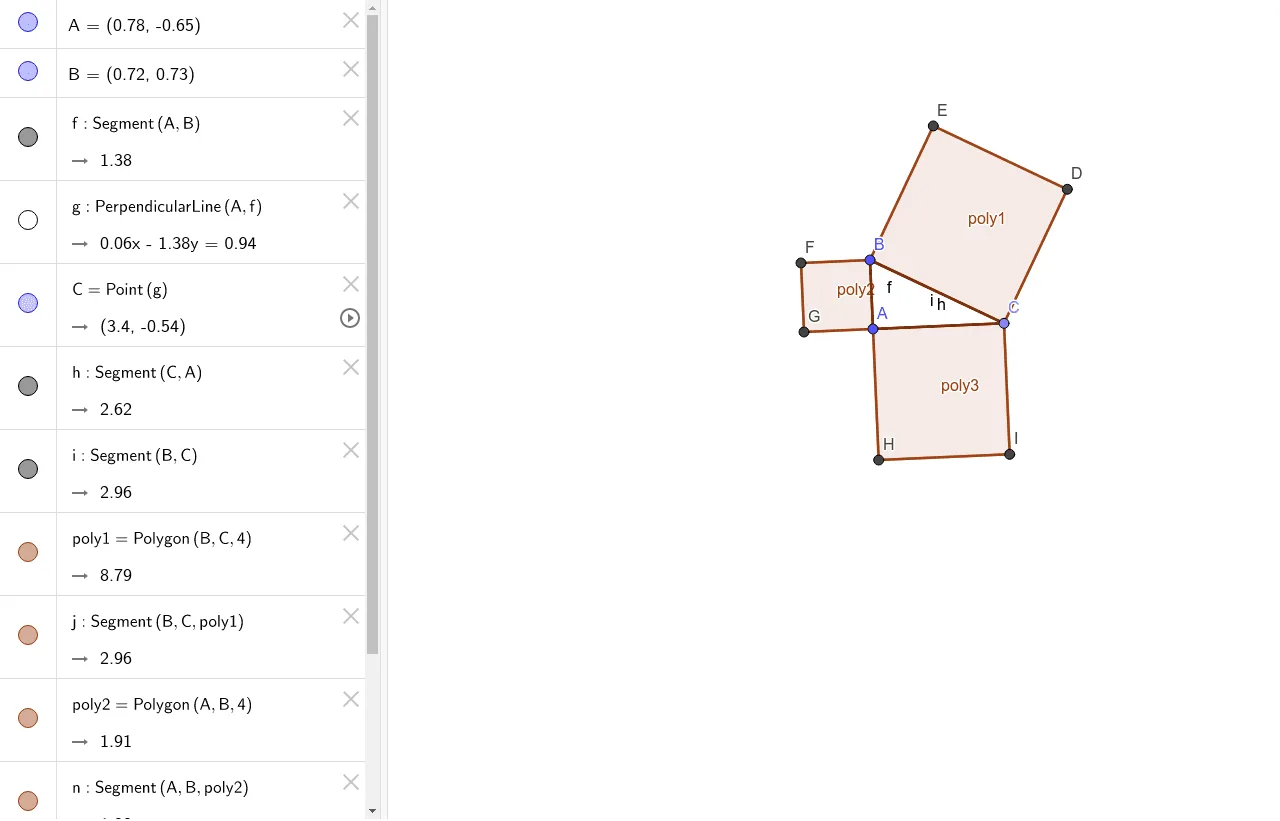
This GeoGebra example dynamically demonstrates the construction and properties of Pythagorean right triangles, i.e., right triangles with integer side lengths. The core mathematical concepts include the Pythagorean theorem, integer triples (Pythagorean triples), triangle perimeter, expected value, and the roles of LCM and GCD in side relationships. Construction highlights: using commands such as Segment, OrthogonalLine, Point, and Polygon, the applet builds three right triangles (ABC, DEF, GHI) with auxiliary segments and intersection objects (A, B, f, g, C, h, i, poly1, etc.) to precisely control side lengths and angles, generating multiple integer-sided right triangles. This resource is suitable for upper secondary to early university students, helping them intuitively grasp integer solutions to the Pythagorean theorem, the connection between perimeter and expected value, and how geometric construction can illuminate number-theoretic ideas. It also serves as an introductory example for integral calculus and expected value applications.
GeoGebra Commands & Parameters
Segment(A, B) → fOrthogonalLine(A, f) → gPoint(g) → CSegment(C, A) → hSegment(B, C) → iPolygon(B, C, 4) → poly1, j, k, l, m, D, EPolygon(A, B, 4) → poly2, n, p, q, r, F, GPolygon(C, A, 4) → poly3, s, t, a, b, H, I