
Pythagoras with Pentagons and Hexagons
Loading the math board and drawing, please wait…
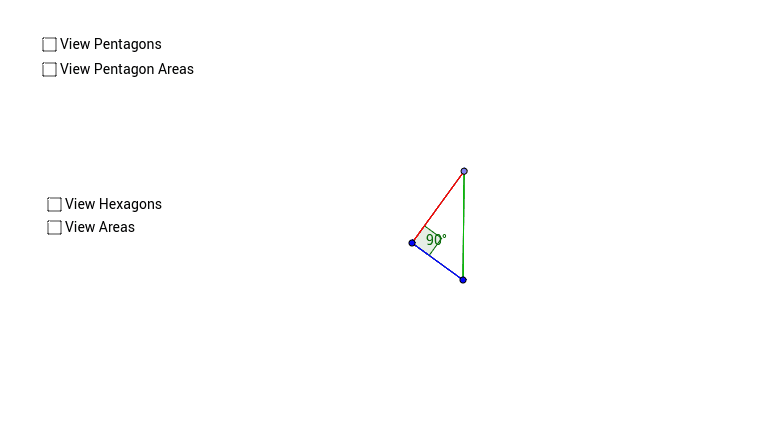
This example demonstrates a visual proof of the Pythagorean theorem by arranging regular pentagons and hexagons. Core concepts include the Pythagorean theorem, interior angles of polygons, area relationships in right triangles, and geometric transformations. Construction uses GeoGebra commands Segment, OrthogonalLine, Point, Polygon, and Angle to create segments, perpendicular lines, vertices, polygons, and angle markers; objects such as poly1, poly2, poly3 and Textpoly1 label the areas. Suitable for middle‑school geometry lessons, high‑school review, and geometric construction practice, serving as a classroom demo or self‑study resource.
GeoGebra Commands & Parameters
Segment(A, B) → aOrthogonalLine(A, a) → bPoint(b) → CSegment(C, B) → cSegment(C, A) → dPolygon(C, B, 5) → poly1, c_1, b_1, e, f, g, D, E, FPolygon(A, C, 5) → poly2, a_1, c_2, h, i, j, G, H, IPolygon(B, A, 5) → poly3, b_2, a_2, k, l, m, J, K, LAngle(B, A, C) → αPolygon(C, B, 6) → poly4, c_3, P, b_3, p, q, r, s, M, N, OPolygon(B, A, 6) → poly5, b_4, T, a_3, t, d_1, e_1, f_1, Q, R, SPolygon(A, C, 6) → poly6, a_4, Z, c_4, g_1, h_1, i_1, j_1, U, V, W
AI Drawing Prompt Reference
Draw a right triangle and use regular pentagons and hexagons to demonstrate the Pythagorean theorem. Start by constructing the two legs and the hypotenuse of the right triangle, then place regular pentagons and hexagons on each side. Shade or color the areas of the polygons to highlight their relationships, showing how the areas relate to the theorem.
The prompt above was compiled from the original drawing commands and is for reference only.