
Pythagoras Theorem Proof Using Polygon Areas
Loading the math board and drawing, please wait…
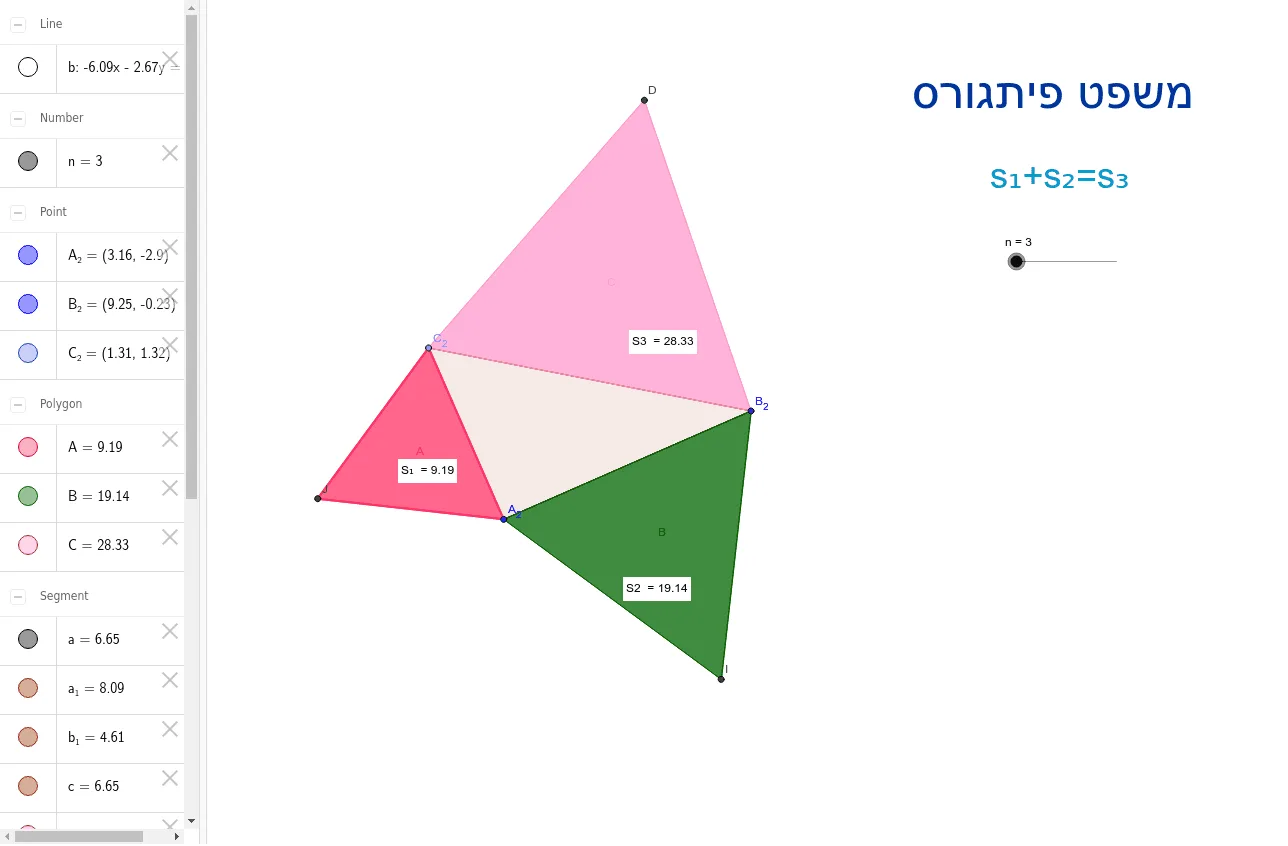
This example demonstrates how to verify the Pythagorean theorem through the area relationship of different polygons (kites). The core mathematical concepts include geometric proof of the Pythagorean theorem, polygon area calculation, and natural number operations. Using GeoGebra's Segment command to draw the three sides of right triangle ABC, OrthogonalLine command to construct kite vertices, and Polygon command to draw two kites containing the right triangles, it intuitively shows that the areas of the two kites are equal, leading to the derivation of a²+b²=c². Suitable for middle school mathematics teaching, serving as visual demonstration material in the Pythagorean theorem chapter to help students understand the mathematical thinking of combining numbers and shapes.
GeoGebra Commands & Parameters
Segment(A_2, B_2) → aOrthogonalLine(A_2, a) → bPoint(b) → C_2Polygon(C_2, B_2, A_2) → poly1, a_1, c, b_1Polygon(C_2, B_2, n) → C, d, p_1, D, E, F, G, H, S, V, A_1, e, f, g, h, i, j, i_1, l_1Polygon(B_2, A_2, n) → B, k, q_1, I, K, M, O, Q, T, W, B_1, l, m, s, c_1, e_1, g_1, j_1, m_1Polygon(A_2, C_2, n) → A, p, r_1, J, L, N, P, R, U, Z, C_1, q, r, t, d_1, f_1, h_1, k_1, n_1