
Pythagoras' Theorem Part 3
Loading the math board and drawing, please wait…
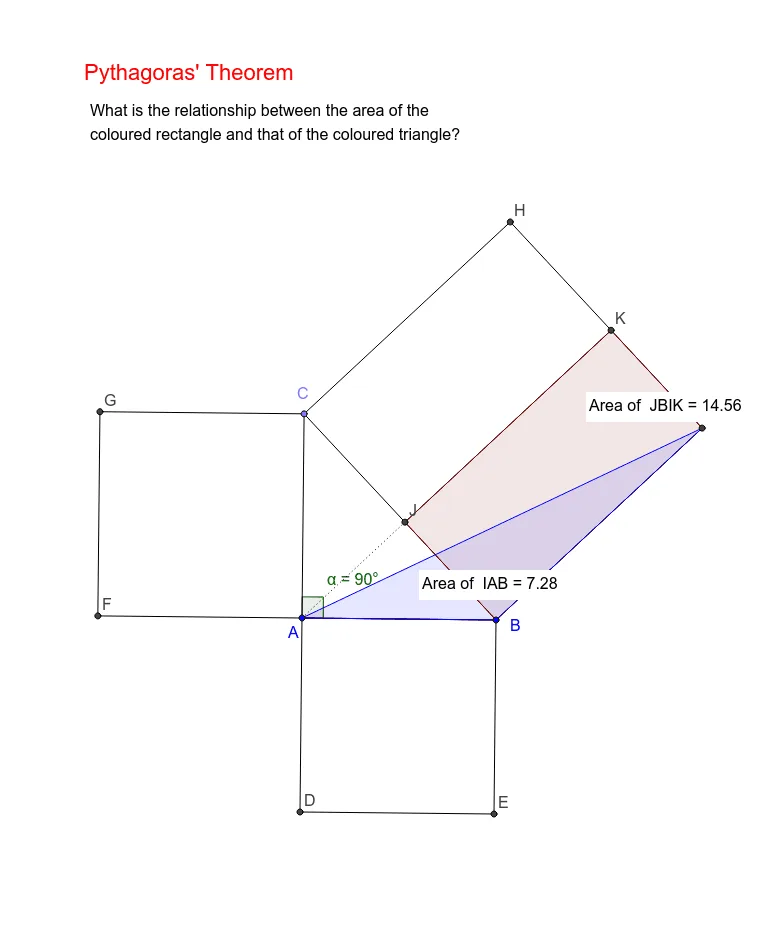
This example demonstrates the application of Pythagoras' theorem in three-dimensional space by constructing right triangles and related vectors to showcase the geometric significance of the theorem. Core mathematical concepts include vectors, triangles, hypergeometric distribution, rational numbers, and congruence. The construction utilizes commands such as Segment, OrthogonalLine, Point, Angle, Circle, Intersect, Polygon, and PointIn in GeoGebra. It is suitable for high school students and educators to explore the integration of spatial geometry and algebraic relationships.
GeoGebra Commands & Parameters
Segment(A, B) → aOrthogonalLine(A, a) → bPoint(b) → CSegment(C, A) → cSegment(C, B) → dAngle(B, A, C) → αCircle(B, A) → eCircle(A, B) → fOrthogonalLine(B, a) → gOrthogonalLine(A, a) → hIntersect(f, h, 1) → DIntersect(e, g, 1) → ESegment(D, E) → iSegment(B, A) → jSegment(A, D) → kSegment(E, B) → lCircle(A, C) → pCircle(C, A) → qOrthogonalLine(A, c) → mIntersect(p, m, 1) → FOrthogonalLine(C, c) → nIntersect(q, n, 1) → GOrthogonalLine(C, d) → rOrthogonalLine(B, d) → sCircle(B, C) → tCircle(C, B) → c_1Intersect(c_1, r, 2) → HIntersect(t, s, 2) → ISegment(B, I) → a_1Segment(I, H) → b_1Segment(H, C) → d_1Segment(C, G) → e_1Segment(F, A) → f_1Segment(F, G) → g_1OrthogonalLine(A, d) → h_1Intersect(h_1, d) → JIntersect(h_1, b_1) → KSegment(A, J) → i_1Segment(J, K) → j_1Polygon(J, B, I, K) → poly1, j_2, b_2, i_2, k_1Polygon(I, A, B) → poly2, b_3, i_3, a_2PointIn(poly1) → Pointpoly1PointIn(poly2) → Pointpoly2
AI Drawing Prompt Reference
In three-dimensional space, draw a right triangle ABC where AB and AC are line segments, and BC is the hypotenuse. Construct a line perpendicular to AB through point A, intersecting at point C. Draw segments from C to A and from C to B, and mark angle alpha. Draw two circles with centers at B and A, with radii AB and AC. Find intersection points D and E of these circles, and connect DE. Draw segment from B to A, and segments from A to D and from B to E. Draw two circles with centers at A and C, with radii AC and BC. Find intersection points F and G of these circles. Draw segment from B to C, and segments from B to D and from C to E. Connect these points to form polygons, and check if points are inside polygons. Show the application of Pythagoras' theorem in three-dimensional space.
The prompt above was compiled from the original drawing commands and is for reference only.