
Pythagoras Theorem Dynamic Geometry Demonstration
Loading the math board and drawing, please wait…
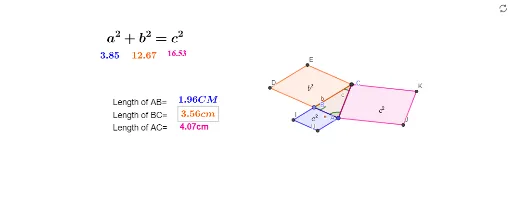
① This GeoGebra example interactively demonstrates the Pythagorean theorem by constructing squares on the three sides of a right triangle, showing that the sum of the areas of the two smaller squares equals the area of the largest square. ② Core mathematical concepts include right triangles, the Pythagorean theorem, area relationships, geometric construction, and dynamic verification. ③ Construction highlights: from the summary, it uses commands such as Semicircle, Point, Circle, Polygon, OrthogonalLine, Intersect, Line, Segment, InteriorAngles, Midpoint, PointIn, and Distance to build the right triangle and squares on its sides, with auxiliary lines, angle labels, and area computations to illustrate the theorem. ④ Suitable for middle school geometry lessons, theorem exploration, or student self-study, and useful for teachers creating dynamic courseware to help learners grasp the geometric meaning of the Pythagorean theorem.
GeoGebra Commands & Parameters
Semicircle(A, C) → c_4Point(c_4) → BCircle(A, B) → pCircle(B, C) → dPolygon(B, A, C) → t1, a, c, bOrthogonalLine(C, b) → hOrthogonalLine(B, b) → gIntersect(d, g, 1) → DLine(D, b) → iIntersect(h, i) → EPolygon(B, C, E, D) → q1, c_2, b_1, e, d_1OrthogonalLine(A, d_1) → kSegment(A, C) → fInteriorAngles(t1) → α, β, γIntersect(d, h) → F, GOrthogonalLine(A, a) → jOrthogonalLine(B, a) → lIntersect(p, k) → H, H_2Line(H, a) → mIntersect(l, m) → IPolygon(A, H, I, B) → q2, a_1, h_1, i_1, c_3OrthogonalLine(A, c) → nOrthogonalLine(C, c) → qCircle(A, C) → rIntersect(r, n, 1) → JLine(J, c) → sIntersect(q, s) → KPolygon(A, J, K, C) → q3, a_2, j_1, k_1, b_2Midpoint(H, B) → LMidpoint(B, E) → MMidpoint(C, J) → NPointIn(q2) → Pointq2PointIn(q3) → Pointq3PointIn(q1) → Pointq1Distance(A, B) → distanceABDistance(B, C) → distanceBCDistance(A, C) → distanceAC
AI Drawing Prompt Reference
Draw a right triangle with its hypotenuse as the diameter of a semicircle, and choose a point on the semicircle as the right-angle vertex. Construct three squares outward on the three sides of the triangle, with the largest square on the hypotenuse. Place a point inside each square and label the side lengths. Show the interior angles of the triangle, and add auxiliary lines to illustrate that the sum of the areas of the two smaller squares equals the area of the largest square. The figure should be dynamic, allowing the vertex to be dragged to observe the area relationship.
The prompt above was compiled from the original drawing commands and is for reference only.