
Pyramid Volume Demonstration by Armin Lässer
Loading the math board and drawing, please wait…
In collections
Area and Volume (III)
S.3 Ch.5 Area and Volume (III)-1
S.3 Ch.5 Area and Volume (III)-2
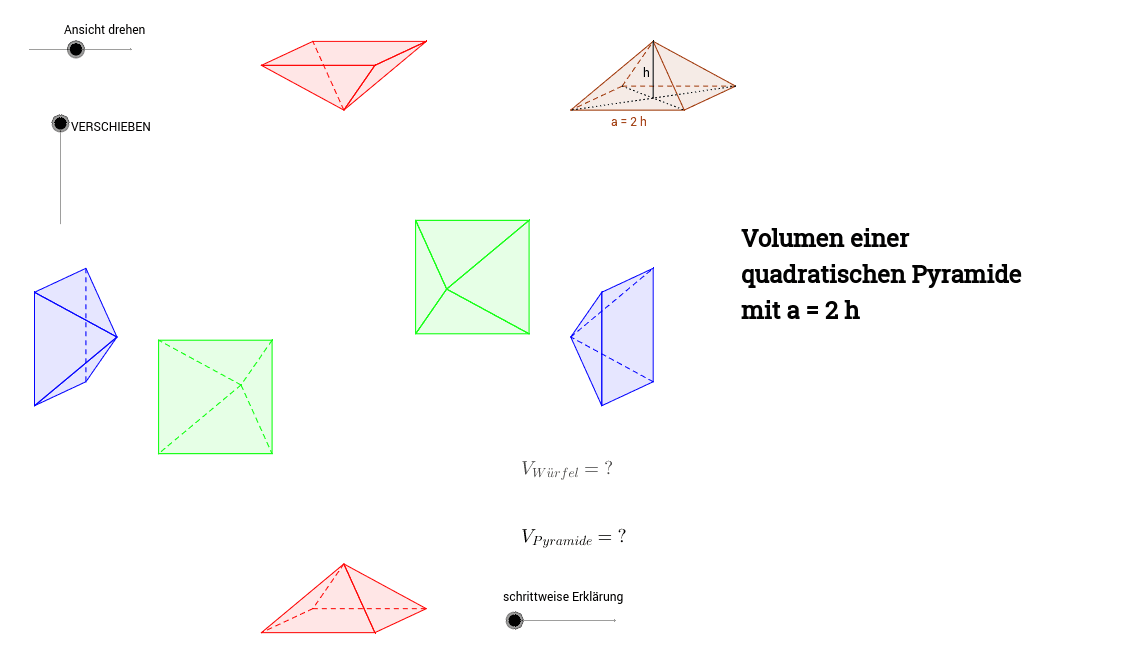
This example demonstrates the pyramid volume formula using the special case where the base length a is twice the height (a = 2h). It utilizes commands like polygon, vector, and rotate in GeoGebra, suitable for middle school and above students studying solid geometry.
GeoGebra Commands & Parameters
Intersect(yAxis, xAxis) → OPolygon(A', B'', C', D) → Vieleck1, a', b, c, dRotate(A', (-α)°, B'') → A'_2Ray(B'', A'_2) → eCircle(B'', v * a') → fIntersect(f, e) → E,Vector(B'', E) → uTranslate(A', u) → A'_1Translate(B'', u) → B'Translate(C', u) → C'_1Translate(D, u) → D'Segment(A'_1, A') → iSegment(A', C'_1) → jSegment(D', B'') → kIntersect(j, k) → FVector(F, O) → wTranslate(C'_1, w) → C''Translate(A', w) → A'_4Translate(D', w) → D''_2Translate(B'', w) → B'_2Translate(D, w) → D'_3Translate(E, w) → E'Translate(C', w) → C'_3Translate(A'_1, w) → IVector(O, A) → zTranslate(D'_3, z) → GTranslate(D''_2, z) → H_1Translate(C'', z) → C'''Translate(C'_3, z) → JMirror(G, O) → G'Mirror(J, O) → J'Mirror(C''', O) → KMirror(H_1, O) → H'Line(O, u) → k_1Vector(O, B) → u_1Translate(C'', u_1) → C'''_1Translate(C'_3, u_1) → LTranslate(B'_2, u_1) → MTranslate(E', u_1) → E''Mirror(A, O) → A'_3Mirror(L, O) → L'Mirror(M, O) → M'Mirror(E'', O) → E'''Mirror(C'''_1, O) → NMirror(B, O) → B'_1Polygon(G, A, J) → Vieleck2, j_1, g_1, a_1Polygon(A, C''', J) → Vieleck3, j_2, a_2, c'''Polygon(H_1, C''', J, G) → Vieleck4, h_1, c'''_1, j_3, g_2Polygon(E''', N, B'_1) → Vieleck5, b'_1, e''', nPolygon(M', B'_1, E''') → Vieleck6, e'''_1, m', b'_2Polygon(B'_1, L', N) → Vieleck7, n_1, b'_3, l'Polygon(C'''_1, L, M, E'') → Vieleck8, c'''_2, l_1, m_1, e''Polygon(L, B, M) → Vieleck9, m_2, l_2, b_1Polygon(K, H', A'_3) → Vieleck10, a'_3, k_2, h'Polygon(G', H', A'_3) → Vieleck11, a'_2, g', h'_1Circle(O, v * a) → pIntersect(p, k_1) → C, PVector(O, P) → qTranslate(C'', q) → C'''_3Translate(D''_2, q) → QTranslate(E', q) → E''_1Translate(I, q) → I'Polygon(Q, P, C'''_3) → Vieleck12, c'''_3, q_1, p_1Polygon(C'''_3, E''_1, P) → Vieleck13, p_2, c'''_4, e''_1Polygon(E''_1, I', P) → Vieleck14, p_3, e''_2, i'Polygon(I', P, Q) → Vieleck15, q_2, i'_1, p_4Mirror(Q, O) → Q'Mirror(C'''_3, O) → RMirror(I', O) → I''Mirror(E''_1, O) → SPolygon(R, Q', I'', S) → Vieleck16, r, q', i'', sSegment(A, H_1) → tSegment(I'', C) → c_1Segment(C, S) → d_1Segment(C, R) → e_1Segment(C, Q') → f_1Segment(B, C'''_1) → i_1Segment(E'', B) → r_1Segment(A'_3, J') → s_1Segment(J', K) → t_1Segment(J', G') → b_2Segment(M', L') → c_2Polygon(E, B'', F) → Vieleck17, f_2, e_2, b''Polygon(F, A', B'') → Vieleck18, b''_1, f_3, a'_1Segment(A'_1, E) → gSegment(A'_1, F) → h_2Segment(A'_1, B'') → lSegment(E, A') → mIntersect(l, m) → TSegment(F, T) → h
AI Drawing Prompt Reference
Draw a pyramid where the base length is twice the height. Start by drawing the base ABCD, then rotate point A to get A', draw a ray from B' through A', and create a circle centered at B' with radius A'B'. Find the intersection E of the circle and the ray. Draw vector u from E to O, and then translate A', B', C', and D' using vector u. Mirror and rotate these points to form four polygons Vieleck1, Vieleck2, Vieleck3, and Vieleck4, illustrating the pyramid volume formula.
The prompt above was compiled from the original drawing commands and is for reference only.