
Pyramid and Circumscribed Circle Construction
Loading the math board and drawing, please wait…
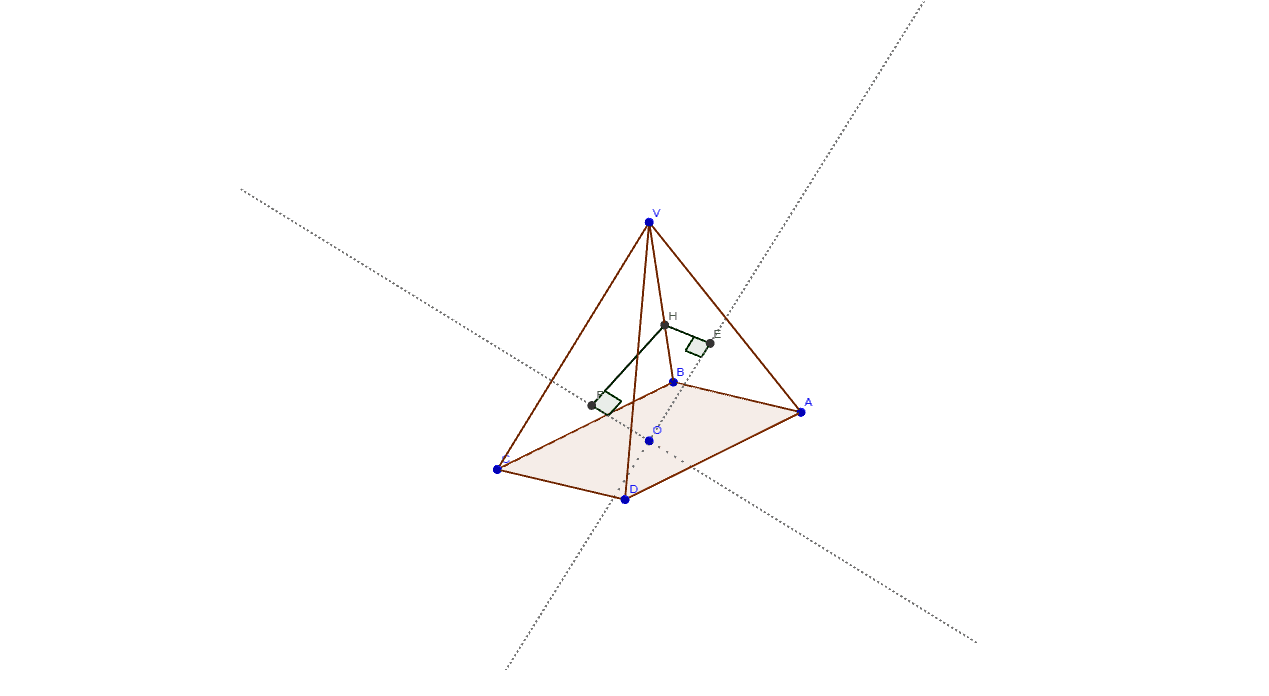
This example demonstrates the geometric construction of a pyramid and its circumscribed circle using GeoGebra. Key math concepts include polygons, solid geometry, angle calculations, and properties of circumscribed circles. Construction highlights from the summary involve commands like Polygon, Pyramid, OrthogonalLine, Intersect, Plane, Segment, and Angle, along with objects A, B, C, D, V, etc. Suitable for high school geometry instruction and construction practice.
GeoGebra Commands & Parameters
Polygon(A, B, C, D) → poly1, a, b, c, dPyramid(poly1, V) → e, faceABV, faceBCV, faceCDV, faceADV, arêteAV, arêteBV, arêteCV, arêteDVOrthogonalLine(O, faceABV) → fOrthogonalLine(O, faceBCV) → gIntersect(f, faceABV) → EIntersect(g, faceBCV) → FPlane(F, E, O) → hIntersect(g, arêteBV) → GIntersect(arêteBV, h) → HSegment(E, H) → iSegment(H, F) → jAngle(O, F, H) → αAngle(O, E, H) → β
AI Drawing Prompt Reference
Construct a pyramid from a quadrilateral and label its apex and edges. Draw perpendicular lines from the center of the base to two adjacent faces, find the feet of the perpendiculars, and connect them to the base center. Measure the angles between the base center and the feet of the perpendiculars to illustrate the geometric properties and relationship with the circumscribed circle of the pyramid.
The prompt above was compiled from the original drawing commands and is for reference only.