
Proportions in Similar Triangles
Loading the math board and drawing, please wait…
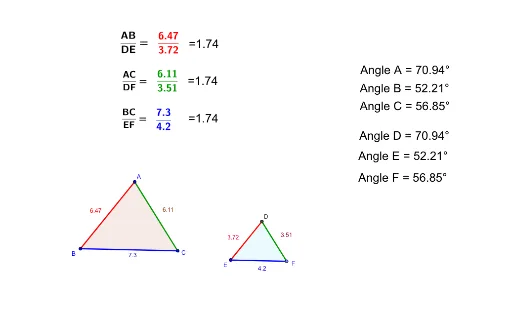
This example demonstrates the proportional relationships between corresponding side lengths in similar triangles. Key math concepts include the criteria and properties of similar triangles, proportional segments, and trigonometric functions. It is constructed using GeoGebra commands like Polygon, Angle, Line, Point, Rotate, Intersect, and Segment. Suitable for high school students learning geometry and trigonometry, it aids in understanding theorems about similar triangles and their practical applications.
GeoGebra Commands & Parameters
Polygon(A, B, C) → P, c, a, bAngle(P) → α, β, γLine(B, C) → dLine(E, d) → ePoint(e) → FRotate(F, β, E) → GAngle(F, E, G) → δRotate(E, (-γ), F) → F_1Angle(F_1, F, E) → εLine(E, G) → hLine(F, F_1) → iIntersect(h, i) → DPolygon(D, E, F) → Q, e_1, h_1, d_1Segment(A, B) → tSegment(D, E) → a_1Segment(B, C) → b_1Segment(E, F) → c_1Segment(A, C) → f_1Segment(D, F) → g_1Angle(E, D, F) → ζ
AI Drawing Prompt Reference
Draw two similar triangles to demonstrate the proportional relationships between corresponding side lengths. Start by drawing a triangle and labeling its three interior angles. Rotate a part of the triangle around one angle to form another triangle. Connect the corresponding vertices of the two triangles, and the intersection point creates a third triangle. Label the sides of all triangles and show that the ratios of corresponding sides are equal.
The prompt above was compiled from the original drawing commands and is for reference only.