
Proportions in Similar Triangles by BacchusRas
Loading the math board and drawing, please wait…
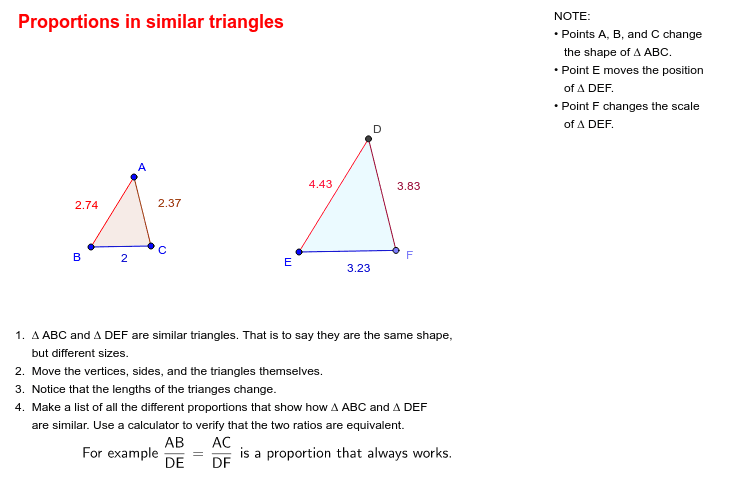
This example demonstrates the proportional relationships between corresponding side lengths in similar triangles. Key math concepts include the criteria and properties of similar triangles, proportional segments, and trigonometric functions. It is constructed using GeoGebra commands like Polygon, Angle, Line, Point, Rotate, and Intersect to create triangles, measure angles and sides, rotate figures, and find intersections. Suitable for high school students to understand the theorem of similar triangles and its practical applications.
GeoGebra Commands & Parameters
Polygon(A, B, C) → P, c, a, bAngle(P) → α, β, γLine(B, C) → dLine(E, d) → ePoint(e) → FRotate(F, β, E) → GAngle(F, E, G) → δRotate(E, -γ, F) → F_1Angle(F_1, F, E) → εLine(E, G) → hLine(F, F_1) → iIntersect(h, i) → DPolygon(D, E, F) → Q, e_1, h_1, d_1
AI Drawing Prompt Reference
Draw two similar triangles PBC and QEF, with PBC formed by points A, B, and C, and QEF by points D, E, and F. First, draw triangle PBC, then use rotation and intersection to find points D, E, and F for triangle QEF, ensuring that angles α, β, γ correspond to angles δ, ε, γ, and use the intersection of lines h and i to determine point D.
The prompt above was compiled from the original drawing commands and is for reference only.