
Properties of Parallelograms Demo by Stephanie Strawska
Loading the math board and drawing, please wait…
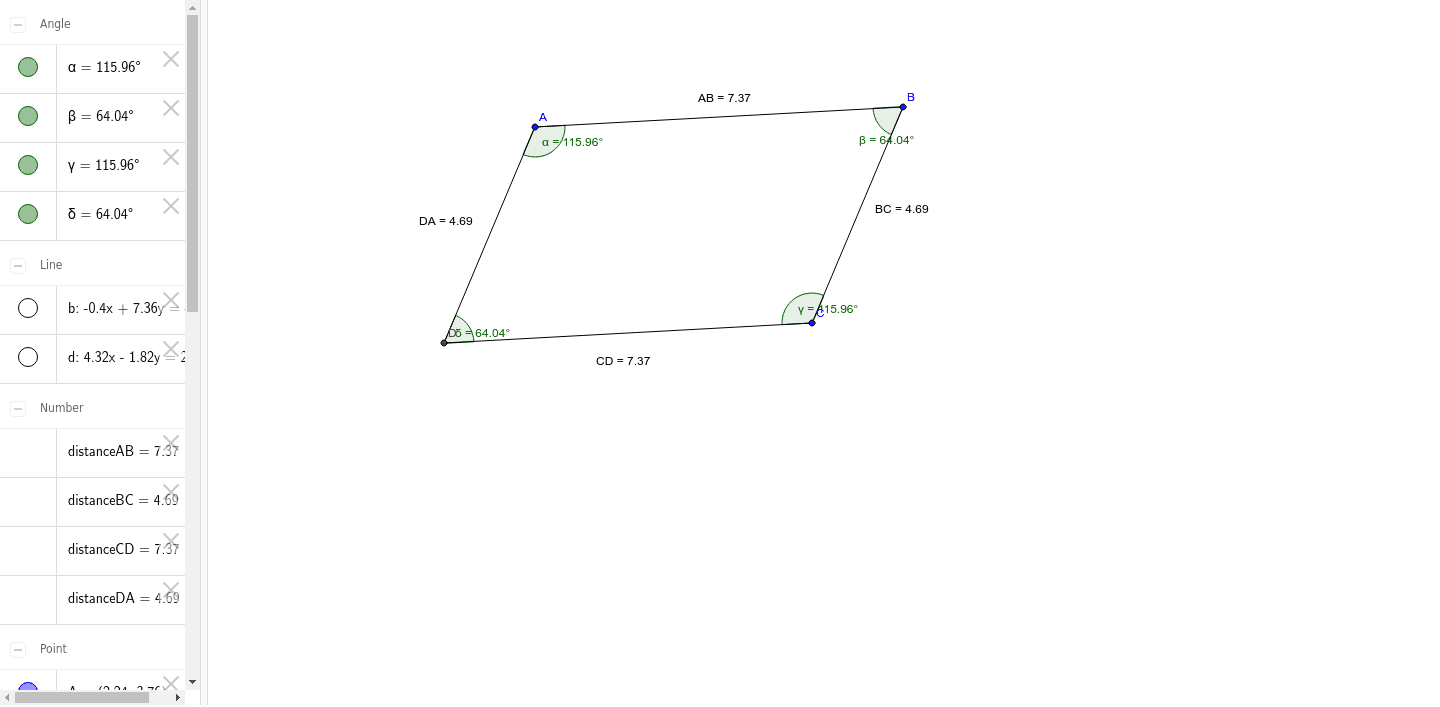
This example demonstrates the geometric properties and calculations of parallelograms. Key math concepts include properties of parallel lines, equal opposite sides, equal opposite angles, and bisecting diagonals. Construction highlights involve using GeoGebra commands like Segment, Line, Intersect, Angle, Distance, and Midpoint to build the parallelogram and measure related attributes. Suitable for middle school and above students learning parallelogram properties or for geometry teaching demonstrations.
GeoGebra Commands & Parameters
Segment(A, B) → aLine(C, a) → bSegment(B, C) → cLine(A, c) → dIntersect(b, d) → DAngle(D, A, B) → αAngle(A, B, C) → βAngle(B, C, D) → γAngle(C, D, A) → δSegment(A, D) → eSegment(D, C) → fDistance(A, B) → distanceABMidpoint(A, B) →Distance(B, C) → distanceBCMidpoint(B, C) →Distance(C, D) → distanceCDMidpoint(C, D) →Distance(D, A) → distanceDAMidpoint(D, A) →
AI Drawing Prompt Reference
Draw a parallelogram by first creating a base segment, then through one endpoint draw a line parallel to a second segment, and through the other endpoint draw another parallel line; the intersection of these two lines gives the fourth vertex. Connect the four vertices to form the parallelogram, and indicate the four interior angles, the lengths of all four sides, and the midpoint of each side.
The prompt above was compiled from the original drawing commands and is for reference only.