
Properties of Kites (Kite Shape Exploration)
Loading the math board and drawing, please wait…
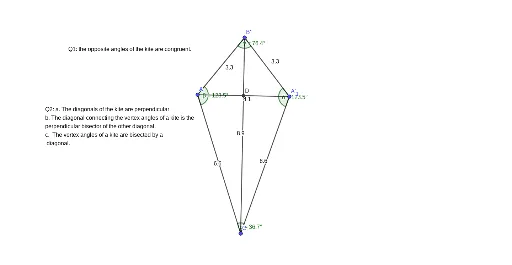
This GeoGebra example dynamically demonstrates the key properties of a kite (a quadrilateral with two pairs of adjacent equal sides), including perpendicular diagonals, one diagonal bisecting the other, and one pair of opposite angles being equal. The core mathematical concepts involve quadrilateral classification, axial symmetry, segment midpoints, angle bisectors, and reflection transformations. The construction uses commands such as Circle, Segment, Mirror, Angle, and Intersect, with objects like A, B, C, D, f, g, h, and their reflected images to build the kite and its symmetry axis. It is suitable for middle school to high school students learning plane geometry, serving as a visual aid for classroom demonstrations or self-study to compare kites with rhombi and other special quadrilaterals. While the original tags also mention derivative and curve sketching, the primary focus here is on verifying geometric properties through interactive construction.
GeoGebra Commands & Parameters
Circle(A, B) → cSegment(A, B) → fCircle(A, C) → dSegment(A, C) → gSegment(B, C) → hMirror(A, h) → A'Mirror(C, h) → C'Segment(A', C') → g'Mirror(A, h) → A'_1Mirror(B, h) → B'Segment(A'_1, B') → f'Angle(A', C, A) → αAngle(C, A, B) → βAngle(A, B, A') → γAngle(B, A', C) → δSegment(B, C) → iSegment(A, A') → jIntersect(i, j) → D