
Properties of Kites – GeoGebra Investigation
Loading the math board and drawing, please wait…
In collections
Adv Geo: Kites, Trapezoids, and Isosceles Trapezoids
Adv Geo: Kites, Trapezoids, and Isosceles Trapezoids
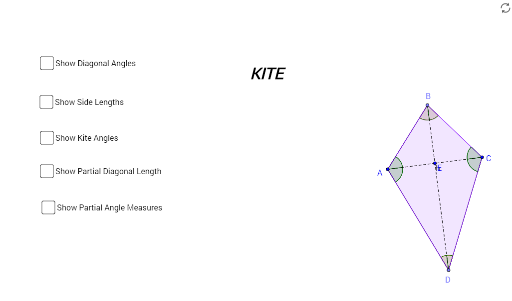
This GeoGebra interactive example guides learners in dynamically exploring the geometric properties of a kite, focusing on relationships among side lengths, interior angles, and diagonals. Key discoveries include which segments are congruent, how diagonals intersect perpendicularly, and how one diagonal bisects the angles. The construction utilizes GeoGebra commands such as Segment, LineBisector, Point, Intersect, Distance, Angle, and Polygon, with defined points A, B, C, D, E and associated distance and angle variables. It is suitable for middle and high school geometry education, supporting classroom inquiry and visual understanding of kite theorems.
GeoGebra Commands & Parameters
Segment(A, C) → aLineBisector(A, C) → bPoint(b) → BPoint(b) → DSegment(A, B) → cSegment(B, C) → dSegment(A, D) → eSegment(C, D) → fSegment(B, D) → gSegment(A, C) → hIntersect(g, h) → EDistance(A, B) → distanceABDistance(B, C) → distanceBCDistance(C, D) → distanceCDDistance(D, A) → distanceDADistance(A, C) → distanceACDistance(B, A) → distanceBADistance(A, E) → distanceAEDistance(C, E) → distanceCEDistance(B, E) → distanceBEDistance(D, E) → distanceDEDistance(B, D) → distanceBDAngle(D, A, B) → αAngle(A, B, C) → βAngle(B, C, D) → γAngle(C, D, A) → δAngle(E, A, B) → εAngle(A, B, E) → ζAngle(E, B, C) → ηAngle(B, C, E) → θAngle(E, C, D) → ιAngle(C, D, E) → κAngle(E, D, A) → λAngle(D, A, E) → μAngle(B, E, A) → νAngle(C, E, B) → ξAngle(D, E, C) → οAngle(A, E, D) → ρPolygon(A, B, C, D) → poly1, a_1, b_1, c_1, d_1Angle(A, B, C) → σAngle(A, B, C) → τAngle(C, D, A) → υAngle(D, A, B) → ϕAngle(B, C, D) → χDistance(A, E) → nDistance(E, C) → distanceECDistance(A, E) → pDistance(E, h) → distanceEhDistance(C, d) → distanceCdDistance(E, d) → distanceEdAngle(A, B, D) → ψAngle(D, B, C) → ωAngle(B, C, A) → α_1Angle(A, C, D) → β_1Angle(C, A, B) → γ_1Angle(D, A, C) → δ_1Angle(C, D, B) → ε_1Angle(B, D, A) → ζ_1
AI Drawing Prompt Reference
Draw a kite ABCD with point E as the intersection of diagonals AC and BD. First, draw diagonal AC, then draw the perpendicular bisector b of AC, and take points B and D on b. Connect AB, BC, CD, and DA to form kite ABCD. Measure the lengths of AB, BC, CD, DA, and AC, as well as the angles ∠A, ∠B, ∠C, ∠D, ∠AEB, ∠BEC, ∠CED, and ∠DEA.
The prompt above was compiled from the original drawing commands and is for reference only.