
Properties of Kite
Loading the math board and drawing, please wait…
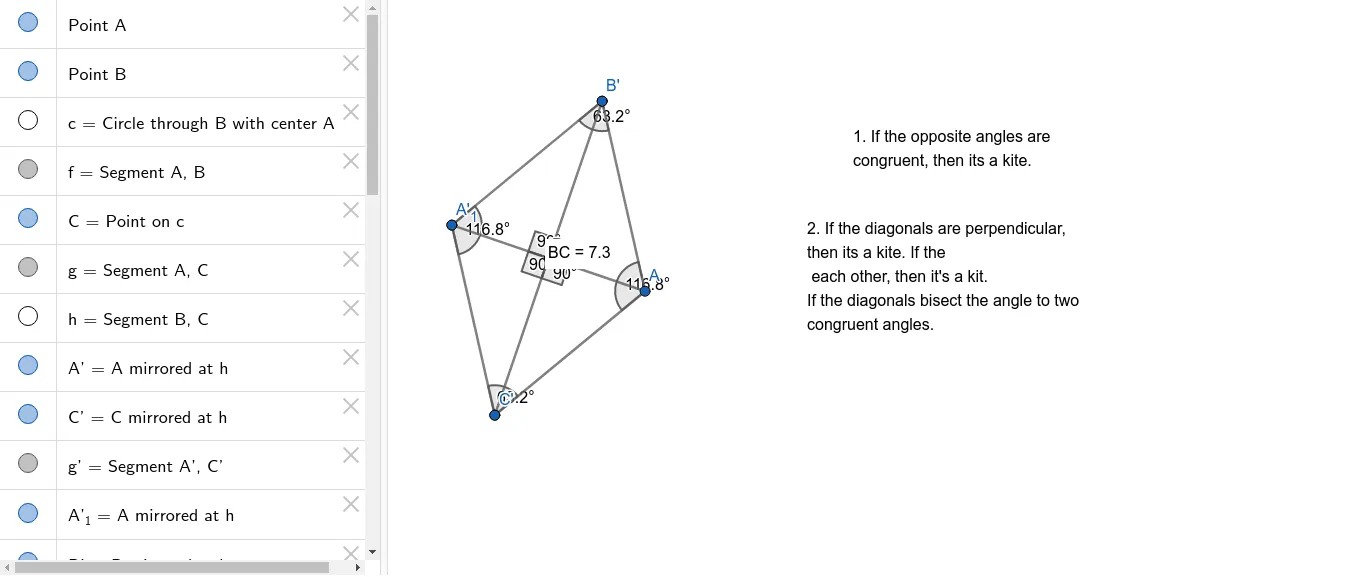
This example demonstrates the properties of a kite. Key mathematical concepts include the definition of a kite, properties of its diagonals, and angle relationships. Using GeoGebra commands such as Circle, Segment, Point, Mirror, Angle, and Intersect, the geometric transformations and properties of a kite are visually illustrated. Suitable for middle school and above students or teachers.
GeoGebra Commands & Parameters
Circle(A, B) → cSegment(A, B) → fPoint(c) → CSegment(A, C) → gSegment(B, C) → hMirror(A, h) → A'Mirror(C, h) → C'Segment(A', C') → g'Mirror(A, h) → A'_1Mirror(B, h) → B'Segment(A'_1, B') → f'Angle(B, A', C) → αAngle(B, A, C) → βAngle(A', B, A) → γAngle(A', C, A) → δSegment(B, C) → iSegment(A, A') → jIntersect(i, j) → DIntersect(i, j) → EAngle(B, D, A) → εAngle(B, D, A') → ζAngle(A', D, C) → ηAngle(A, D, C) → θDistance(A', A) → distanceA'AMidpoint(A', A) →Distance(B, C) → distanceBCMidpoint(B, C) →
AI Drawing Prompt Reference
Draw a kite shape: start with a base segment, then draw a circle centered at one endpoint with the base as radius. Pick a point on the circle and connect it to both endpoints of the base to form a triangle. Reflect the other two vertices of this triangle across the base to create a symmetric triangle, forming the kite. Mark the four angles at the kite's vertices and the four angles at the intersection of the diagonals. Draw the axis of symmetry segment and mark its intersection with the base. Measure the lengths of the axis and the base, and mark their midpoints.
The prompt above was compiled from the original drawing commands and is for reference only.