
Properties of an Isosceles Trapezoid by Alfred Estberg
Loading the math board and drawing, please wait…
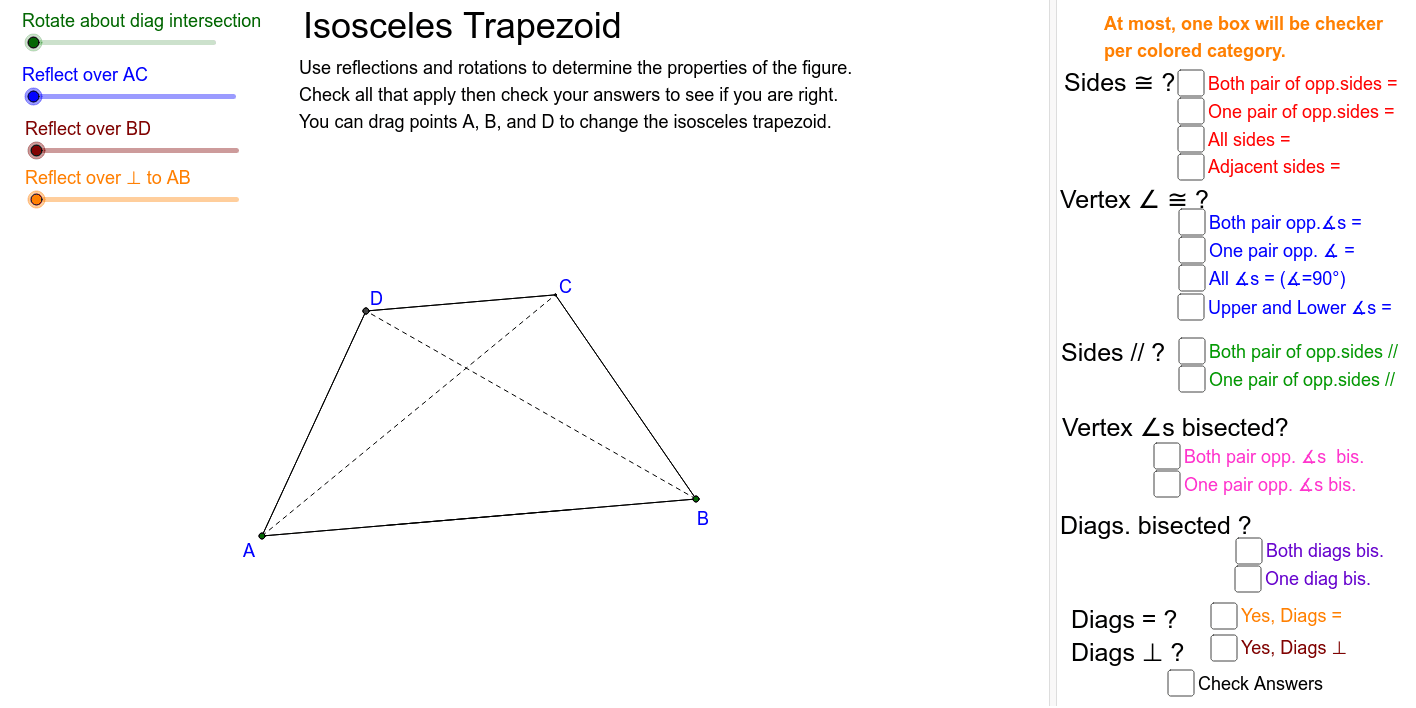
This example demonstrates the geometric properties and symmetry of an isosceles trapezoid. Key math concepts include polygons, symmetry axes, midlines, and angle relationships. Construction highlights involve commands like Segment, LineBisector, Mirror, Intersect, Circle, Polygon, Rotate, OrthogonalLine to draw and analyze the trapezoid's symmetry. Suitable for middle school and above students learning geometric constructions and property exploration.
GeoGebra Commands & Parameters
Segment(A, B) → aSegment(D, A) → bLineBisector(a) → cMirror(D, c) → CSegment(D, C) → dSegment(C, B) → eSegment(A, C) → fSegment(B, D) → gIntersect(f, g) → EMirror(B, f) → B'Circle(B, (Distance[B, B'] * ReflectAC / 10)) → hIntersect(h, Segment[B, B']) → F, GPolygon(A, C, F) → poly1, j, l, mMirror(A, g) → A'Circle(A, (Distance[A, A'] * ReflectBD / 10)) → kIntersect(k, Segment[A, A']) → I, JPolygon(D, B, J) → poly2, i, n, pPolygon(A, B, C, D) → poly3, a_1, b_1, c_1, d_1Rotate(A, α, E) → A'_1Rotate(B, α, E) → B'_1Rotate(C, α, E) → C'Rotate(D, α, E) → D'Polygon(A'_1, B'_1, C', D') → poly3', a'_1, b'_1, c', d'Segment(A'_1, C') → qSegment(B'_1, D') → rOrthogonalLine(D, d) → sOrthogonalLine(C, d) → tIntersect(s, a) → HIntersect(t, a) → KSegment(H, K) → f_1LineBisector(A, B) → g_1Intersect(g_1, d) → LIntersect(g_1, a) → MCircle(A, (ReflectPerp * Segment[A, B])) → e_1Circle(D, (ReflectPerp * Segment[C, D])) → h_1Intersect(h_1, d, 1) → NIntersect(e_1, a, 1) → OPolygon(L, N, O, M) → q1, l_2, n_2, o, m_2Intersect(h_1, d, 2) → PPolygon(P, L, M, O) → q2, p_2, l_3, m_3, o_2Polygon(D, B, I) → t1, i_2, d_2, b_2Polygon(A, C, G) → t2, g_2, a_2, c_2