
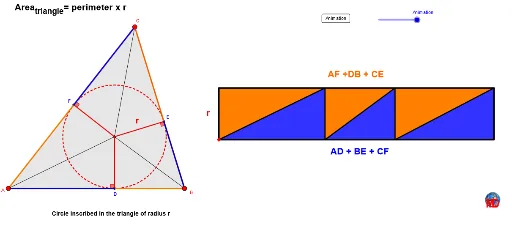
Proof without words: Area of the triangle
Loading the math board and drawing, please wait…
This example dynamically demonstrates the proof of the triangle area formula. It involves core concepts like triangle area, circle, tangent line, inequalities, ratios, circumcircle, and median line. Constructed using commands such as Segment, Line, Point, AngularBisector, Intersect, OrthogonalLine, Translate, Circle, Angle, Polygon, Midpoint, etc. Suitable for high school mathematics teaching or exploration by geometry enthusiasts.
GeoGebra Commands & Parameters
Segment(C, A) → dLine(A, xAxis) → aPoint(Ray[A, A + (1, 0)]) → BAngularBisector(C, B, A) → fAngularBisector(B, A, C) → eIntersect(e, f) → IOrthogonalLine(I, d) → hIntersect(h, d) → FOrthogonalLine(I, a) → gIntersect(g, a) → DTranslate(P, Vector[A, D]) → G'Translate(G', Vector[D, B]) → G''Segment(B, C) → cOrthogonalLine(I, c) → iIntersect(i, c) → ESegment(A, B) → bCircle(I, D) → kSegment(I, A) → jSegment(I, B) → lSegment(I, C) → mSegment(I, D) → nSegment(I, E) → pSegment(I, F) → qTranslate(G', Vector[D, I]) → G''_1Translate(G'', Vector[D, I]) → G'''Translate(Rotate[F, (-(180° + Angle[B, A, C])), C], Vector[C, G'']) → RTranslate(R, Vector[D, I]) → H'Translate(P, Vector[D, I]) → QSegment(P, Q) → rSegment(P, R) → t_1Angle(I, D, A) → αAngle(I, E, B) → βAngle(I, F, C) → γPolygon(P, R, H', Q) → poly1, p_1, r_1, h', q_1Segment(A, D) → sSegment(B, E) → a_1Segment(C, F) → b_1Midpoint(q_1) → GPolygon(C, A, B) → poly2, b_2, c_1, a_2Midpoint(h') → HMidpoint(t_1) → J
AI Drawing Prompt Reference
Draw a triangle with its base on a horizontal line and the apex above. Construct the angle bisectors from the apex to the base endpoints, intersecting at the incenter. From the incenter, drop perpendiculars to all three sides, marking the feet. Draw a circle centered at the incenter passing through one foot, tangent to the sides. Translate a foot along the base to form a rectangle equal in area to the triangle, with one side parallel to the base and the other through the incenter. Inside the rectangle, draw segments from the incenter to each vertex, and label three small angles corresponding to the triangle's vertices. Finally, show that the triangle's area equals the rectangle's area, i.e., half base times height.
The prompt above was compiled from the original drawing commands and is for reference only.