
Proof of Sine Rule
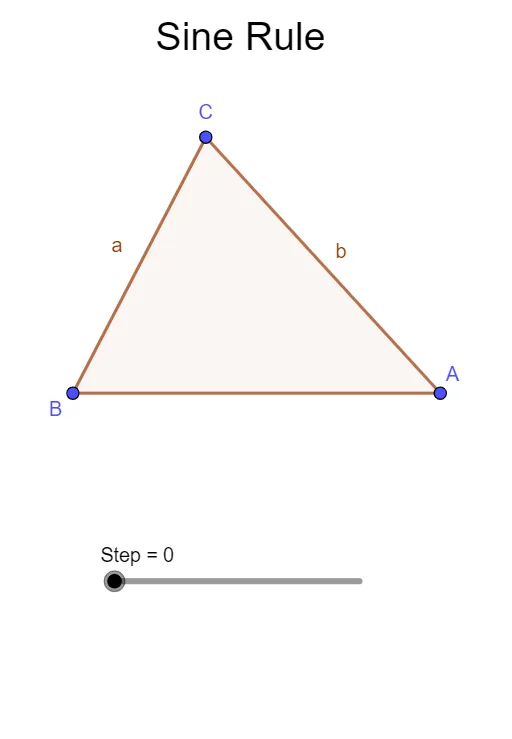
Loading the math board and drawing, please wait…
This GeoGebra example demonstrates a geometric proof of the Sine Rule through dynamic construction, showing how the relationship between sides and angles in a triangle leads to the formula. Key mathematical concepts involved include the Sine Rule, trigonometric functions (specifically sine), properties of triangle angles, and side-angle correspondences. In terms of construction, it utilizes commands such as Polygon to form triangle ABC, Line and OrthogonalLine to draw lines and perpendiculars for auxiliary heights, Angle to mark angles, Intersect for intersection points, and Segments for line segments; objects like points A, B, C define the triangle, while others like β, γ, α represent angles, and text objects add proof annotations. This example is suitable for high school or introductory college-level trigonometry courses, serving as a visual aid to enhance understanding of the Sine Rule derivation.
GeoGebra Commands & Parameters
Polygon(A, B, C) → t1, e, a, bLine(B, A) → fOrthogonalLine(C, f) → gAngle(B, C, A) → βAngle(A, B, C) → γLine(B, A) → hOrthogonalLine(C, h) → iIntersect(h, i) → DAngle(C, D, B) → αSegment(C, D) → jAngle(B, D, C) → δSegment(D, B) → kAngle(C, A, B) → ε
AI Drawing Prompt Reference
Draw a triangle with vertices labeled A, B, and C. From vertex C, draw a perpendicular line to side AB, and mark the foot of the perpendicular as D. Label the three interior angles of the triangle as angle A, angle B, and angle C. Also label the angles formed by the perpendicular: angle CDB and angle BDC. Connect C to D and D to B with line segments. Add text annotations to illustrate the geometric proof of the sine rule, emphasizing the relationship between sides and the sine of their opposite angles.
The prompt above was compiled from the original drawing commands and is for reference only.