
Proof of Addition: Geometric Demonstration with Circles and Rotation
Loading the math board and drawing, please wait…
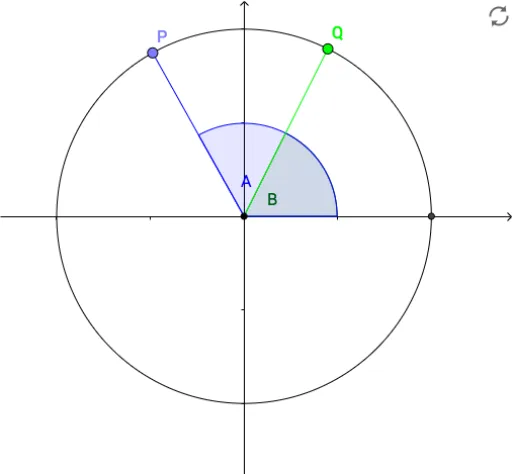
① This GeoGebra example illustrates the geometric proof of addition by constructing circles, points, angles, and rotations, showing how the sum of two numbers can be represented through geometric relationships. ② The core mathematical concepts include addition, multiplication, quadratic functions, scatter plots, linear regression, and surfaces, but the primary focus is on using geometric construction to prove the result of addition, likely through angle measures or segment lengths on a circle. ③ The construction employs GeoGebra commands such as Circle, Point, Angle, Rotate, Intersect, and Segment, creating objects like A_1, R_1, c, Q, P, B, A, R, S, α, C, f, g, h, i. The circle c and rotation operations are central, with angle α and intersection points establishing the additive relationship. ④ This is suitable for middle school and above, serving as an interactive teaching tool for demonstrating the geometric interpretation of addition, bridging algebra and geometry, and helping students visualize arithmetic operations in a dynamic environment.
GeoGebra Commands & Parameters
Circle(A_1, R_1) → cPoint(c) → QPoint(c) → PAngle(R_1, A_1, Q) → BAngle(R_1, A_1, P) → APoint(c) → RRotate(R, 55.75°, A_1) → SAngle(R, A_1, S) → αIntersect(c, xAxis, 2) → CSegment(A_1, P) → fSegment(A_1, Q) → gSegment(A_1, S) → hSegment(A_1, R) → i