
Projectiles without Air Resistance
Loading the math board and drawing, please wait…
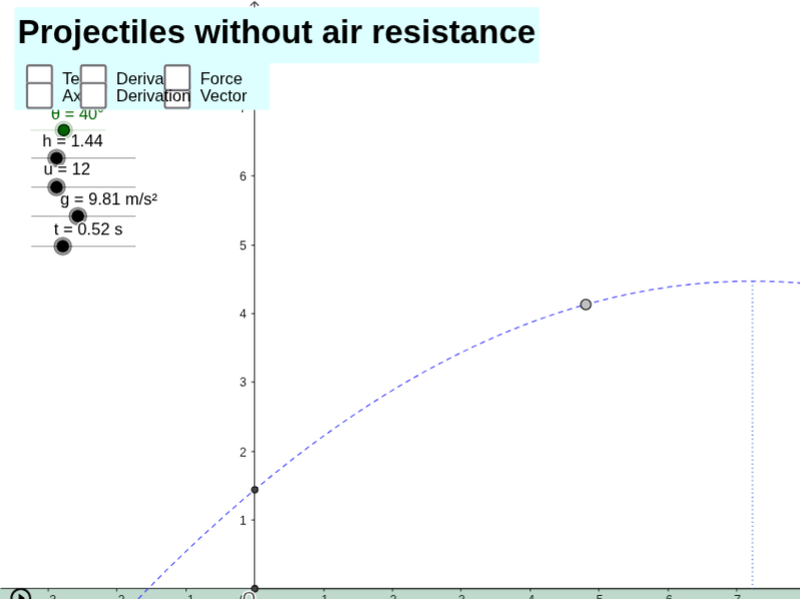
This example demonstrates the motion trajectory of a projectile thrown from a certain height above horizontal ground without air resistance. It involves core mathematical concepts such as parabola, kinematic equations, trigonometry, and calculus. Construction highlights include using GeoGebra commands like Intersect, Segment, LineBisector, Line, Point, Rotate, Angle, Vector, and Polygon. Suitable for high school physics and mathematics courses to understand projectile motion principles and parameter effects.
GeoGebra Commands & Parameters
Intersect(xAxis, yAxis) → OIntersect(T, xAxis) → A, ISegment(O, I) → R'Intersect(T, yAxis) → B,LineBisector(A, I) → mIntersect(T, m) → C,Intersect(m, xAxis) → KSegment(C, K) → H'Segment(N, W) → wSegment(M, j) → j'Segment(M, i) → i'Line(B, xAxis) → nPoint(n) → PRotate(P, θ, B) → UAngle(P, B, U) → αVector(B, U) → u_1Polygon(Q, Q', Q'', Q''') → Ground, q, q', q'', q'''
AI Drawing Prompt Reference
Draw a parabolic trajectory starting above horizontal ground, showing motion without air resistance. Include the intersection point of the horizontal ground and vertical axis, the vertex of the parabola, and a perpendicular line from the vertex to the ground. Mark the intersection point of this perpendicular with the ground and draw a line segment from this point to the vertex. Finally, select a point on the trajectory, draw a horizontal vector to the right from this point, and outline the area including the ground, the perpendicular, and part of the trajectory.
The prompt above was compiled from the original drawing commands and is for reference only.