
Prism Dispersion Demo
Loading the math board and drawing, please wait…
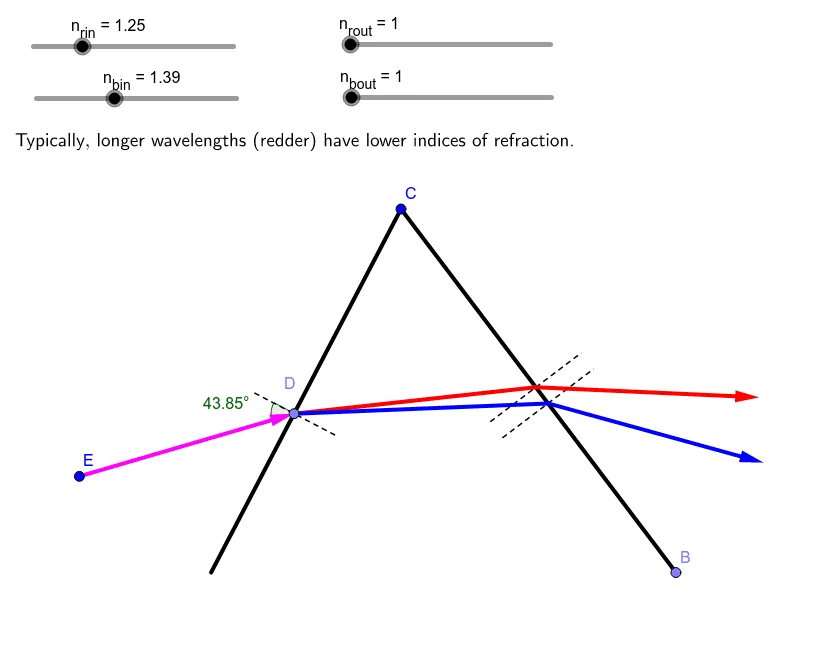
This example demonstrates the dispersion of light through a prism, involving concepts like refractive index, angle calculations, vector operations, and geometric constructions. It uses commands like Point, Intersect, Segment, Slope, CircleSector, PointIn, Vector, Angle, Rotate, Ray, and LaTeX in GeoGebra for construction. Suitable for high school physics and mathematics education to understand the principle of light dispersion and geometric optics.
GeoGebra Commands & Parameters
Point(xAxis) → BIntersect(xAxis, yAxis) → ASegment(C, A) → cSlope(c) → m_cPoint(c) → DCircleSector(D, D - (Length[c] * (1, (-1) / m_c)), A) → kSegment(C, B) → bPointIn(k) → EVector(E, D) → uSlope(b) → m_bSegment(D_{plus}, D_{minus}) → aAngle(E, D, D_{minus}) → daRotate(D_{plus}, (db / 180 * π), D) → FRay(D, F) → dIntersect(d, b) → GSegment(D, G) → eSegment(G_{minus}, G_{plus}) → fAngle(D, G, G_{minus}) → gaRotate(G_{plus}, (((-gb)) / 180 * π), G) → HVector(G, G + (Vector[G, H] / Length[Vector[G, H]] * Length[u])) → gRotate(D_{plus}, (db2 / 180 * π), D) → IRay(D, I) → hIntersect(h, b) → JSegment(J_{minus}, J_{plus}) → iAngle(D, J, J_{minus}) → jaRotate(J_{plus}, (((-jb)) / 180 * π), J) → KVector(J, J + (Vector[J, K] / Length[Vector[J, K]] * Length[u])) → wSegment(D, J) → jLaTeX("\text{Typically, longer wavelengths (redder) have lower indices of refraction.}") → text1
AI Drawing Prompt Reference
Draw a prism dispersion demonstration, starting with point A at the intersection of the x-axis and y-axis, and point B on the x-axis. Draw line segment c through points A and B, and calculate its slope m_c. Find point D on line segment c, and draw a circular sector k with D as the center and the length of c as the radius. Find point E within sector k, and draw vector u from E to D. Calculate the slope m_b of line segment b, and draw line segment b. Find the midpoint D_+ and D_- of line segment b, rotate D_+ to get point F, draw ray d, and find its intersection with b at point G. Draw line segment e. Repeat the process to draw line segments f and g, find the intersection of b at point J, draw line segments i and j. Finally, add a text note explaining that longer wavelengths (redder) have lower indices of refraction.
The prompt above was compiled from the original drawing commands and is for reference only.