
Practice with Multiplying, Dividing, and Estimating in Scientific Notation
Loading the math board and drawing, please wait…
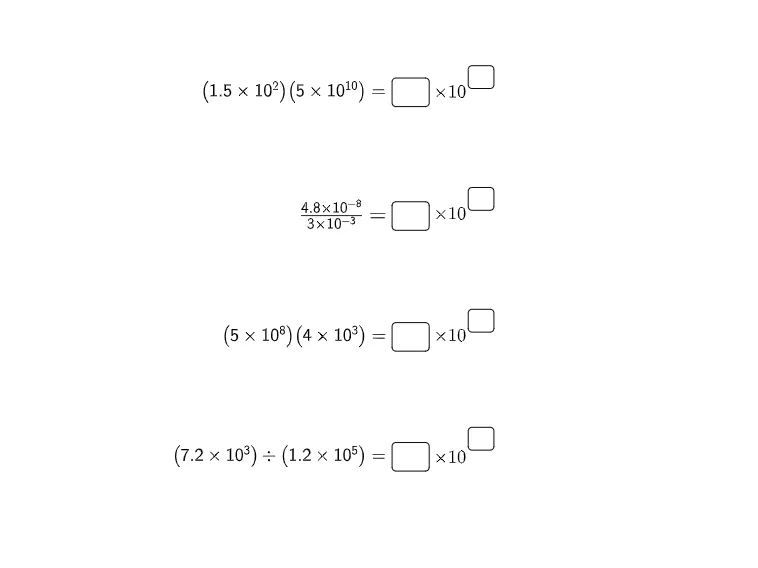
This example demonstrates how to multiply and divide numbers written in scientific notation, and how to estimate using orders of magnitude to check whether an exact result is reasonable. Key concepts include writing and reading numbers in scientific notation, exponent rules for products and quotients, using magnitude (order-of-magnitude) estimation, and the role of estimation in validating calculations and reducing error. In the construction, the setup relies on multiple text input fields: several Textfield objects (InputBox1–InputBox8 and text5–text8) are used to enter parameters and display intermediate values and final outcomes, enabling a tight “exact computation vs. estimation” workflow. Suitable for middle and high school learners and math practice/teaching contexts focused on arithmetic, exponents, and estimation strategies.
GeoGebra Commands & Parameters
Textfield() → InputBox1Textfield() → InputBox2Textfield() → InputBox3Textfield() → InputBox4Textfield() → InputBox5Textfield() → InputBox6Textfield() → InputBox7Textfield() → InputBox8
AI Drawing Prompt Reference
Create a math illustration with multiple text input fields to enter parameters and display calculation results, demonstrating multiplication and division in scientific notation and estimation methods, showing intermediate values and final outcomes through input boxes and text, emphasizing the comparison between exact computation and estimation, suitable for middle and high school learning and teaching contexts.
The prompt above was compiled from the original drawing commands and is for reference only.