
Polygon Intersection Demo
Loading the math board and drawing, please wait…
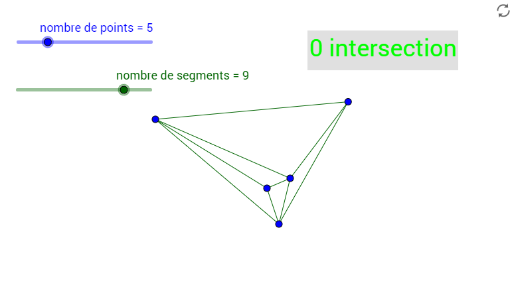
This example demonstrates the calculation and visualization of intersections between polygons and geometric shapes, involving core concepts like intersection points, equilateral triangles, polygons, integers, spheres, and random variables. It uses GeoGebra commands such as First, Sequence, RemoveUndefined, Length, and objects like np, ns, P-series points, P, indmel, S, intersect, li, texte1 for construction. Suitable for high school mathematics students and educators exploring geometric intersections and parametric graphs.
GeoGebra Commands & Parameters
First({P_{1}, P_{2}, P_{3}, P_{4}, P_{5}, P_{6}, P_{7}, P_{8}, P_{9}, P_{10}, P_{11}, P_{12}}, np) → PSequence(Segment[Element[P, x(Element[indmel, i])], Element[P, y(Element[indmel, i])]], i, 1, ns) → SRemoveUndefined(Join[Sequence[Sequence[If[(x(indmel(i)) ≠ x(indmel(j))) ∧ (y(indmel(i)) ≠ y(indmel(j))) ∧ (x(indmel(i)) ≠ y(indmel(j))) ∧ (y(indmel(i)) ≠ x(indmel(j))), Intersect[Element[S, i], Element[S, j]]], i, j + 1, ns], j, 1, ns - 1]]) → intersectLength(intersect) → li
AI Drawing Prompt Reference
Draw a polygon with 12 vertices and calculate its intersections with other polygons. First, create a polygon P with 12 points. Then, generate a series of segments S connecting every two points in polygon P. Next, find the intersections between all pairs of segments and store them in intersect. Finally, count the number of intersections in intersect and store it as li.
The prompt above was compiled from the original drawing commands and is for reference only.