
Polar Coordinates of Complex Numbers
Loading the math board and drawing, please wait…
In collections
Complex numbers
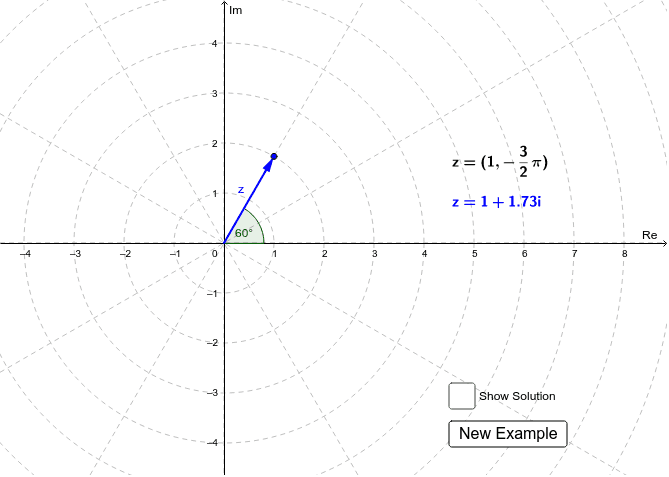
This interactive worksheet demonstrates how complex numbers can be represented in polar coordinates, showing the modulus and argument on the complex plane. It helps students grasp the geometric meaning of complex numbers, including the polar form, Euler's formula, and how multiplication relates to rotation and scaling. The construction uses GeoGebra commands such as Random to generate random complex numbers, GCD for auxiliary calculations, Intersect, Vector, Point, and Angle to plot points, vectors, and angles, along with a button (button1) and showSolution toggle for interactive feedback. Multiple text objects (text1 to text13) display step-by-step results. Suitable for high school or introductory college students learning complex numbers and polar coordinates, as well as for classroom demonstrations or self-study.
GeoGebra Commands & Parameters
Random(1, 4) → rRandom(-24, 24) → wGCD(w, 6) → ggTIntersect(xAxis, yAxis) → AVector(A, Z) → zVector(A, Z_S) → z_sPoint(xAxis) → BAngle(B, A, Z) → α
AI Drawing Prompt Reference
Draw a complex plane with a randomly generated complex number represented as a point. From the origin, draw a vector to this point, and display its modulus and argument. Also plot the projection of the point onto the real axis, and mark the angle from the positive real axis to the vector. Include a button that toggles a text panel showing step-by-step calculations of the modulus, argument, and Euler's formula. The layout should be clean and suitable for classroom use.
The prompt above was compiled from the original drawing commands and is for reference only.