
Point Dilation
Loading the math board and drawing, please wait…
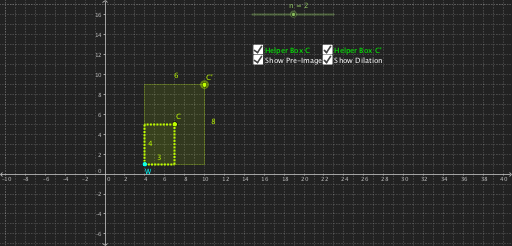
This example demonstrates the transformation of a point under dilation in a 2D coordinate system. Key math concepts include dilation, vectors, and coordinate geometry. It uses commands like Line, Intersect, Polygon, and Dilate in GeoGebra to construct the illustration, making it suitable for high school students learning geometric transformations.
GeoGebra Commands & Parameters
Line(W, xAxis) → f_2Line(W, yAxis) → g_2Line(C, f_2) → hLine(C, g_2) → iIntersect(f_2, i) → EIntersect(g_2, h) → FPolygon(W, E, C, F) → poly2, d_6, e, a_1, f_1Dilate(C, n, W) → C'Line(C', f_2) → t_1Intersect(g_2, t_1) → PLine(C', i) → fIntersect(f_2, f) → AIntersect(g_2, t_1) → BPolygon(W, A, C', B) → poly1, w_1, a, c', b
AI Drawing Prompt Reference
Draw a 2D coordinate system with origin W and x-axis, y-axis. Take point C on the x-axis, draw a line h parallel to the y-axis through C, and draw a line i parallel to the x-axis, which intersects the y-axis at point F and line h at point E. Use W as the center of dilation with ratio n to dilate point C to C'. Draw a line t_1 through C' parallel to h, which intersects the y-axis at point P. Draw a line f through C' and i, which intersects h at point A and t_1 at point B. Finally, draw a quadrilateral with points W, A, C', and B.
The prompt above was compiled from the original drawing commands and is for reference only.