
Place Value Blocks
Loading the math board and drawing, please wait…
In collections
Concrete-Pictorial-Abstract and the Teaching for Mastery
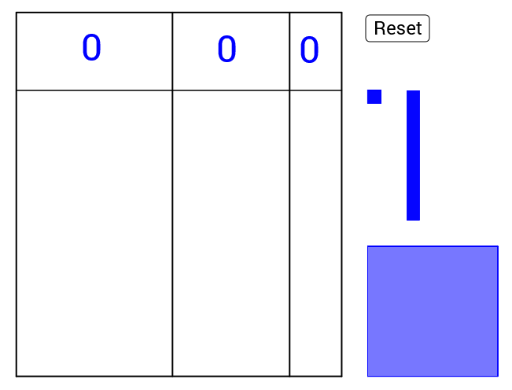
This example demonstrates how place value blocks represent and decompose different numbers. It involves core math concepts like place value, decimal system, addition, and subtraction. GeoGebra commands used include If, Polygon, Segment, Point, and Sum for construction. Suitable for elementary mathematics education to help students understand number concepts and operations.
GeoGebra Commands & Parameters
If(v ≟ true, 1, 0) → F4If((E2 > 5) ∧ (E2 < 16), 1, 0) → F2If((E1 > 5) ∧ (E1 < 16), 1, 0) → F1If((C12 < 26) ∧ (C12 > 17), 1, 0) → D12Polygon(A, B, 4) → poly1, f, g, h, i, C, DPolygon(A_1, B_1, 4) → poly1_1, f_1, g_1, h_1, i_1, C_1, D_1Polygon(A_2, B_2, 4) → poly1_2, f_2, g_2, h_2, i_2, C_2, D_2Polygon(A_3, B_3, 4) → poly1_3, f_3, g_3, h_3, i_3, C_3, D_3Polygon(A_4, B_4, 4) → poly1_4, f_4, g_4, h_4, i_4, C_4, D_4Polygon(A_5, B_5, 4) → poly1_5, f_5, g_5, h_5, i_5, C_5, D_5Polygon(A_6, B_6, 4) → poly1_6, f_6, g_6, h_6, i_6, C_6, D_6Polygon(A_7, B_7, 4) → poly1_7, f_7, g_7, h_7, i_7, C_7, D_7Polygon(A_8, B_8, 4) → poly1_8, f_8, g_8, h_8, i_8, C_8, D_8Polygon(A_9, B_9, 4) → poly1_9, f_9, g_9, h_9, i_9, C_9, D_9Segment(E, F) → jSegment(G, H) → kSegment(I, J) → lSegment(K, L) → mSegment(K, I) → nSegment(L, J) → qPolygon(O, P, Q, R) → poly2, o, p_1, q_1, rPolygon(O_1, P_1, Q_1, R_1) → poly2_1, o_1, p_2, q_2, r_1Polygon(O_2, P_2, Q_2, R_2) → poly2_2, o_2, p_3, q_3, r_2Polygon(O_3, P_3, Q_3, R_3) → poly2_3, o_3, p_4, q_4, r_3Polygon(O_4, P_4, Q_4, R_4) → poly2_4, o_4, p_5, q_5, r_4Polygon(O_5, P_5, Q_5, R_5) → poly2_5, o_5, p_6, q_6, r_5Polygon(O_6, P_6, Q_6, R_6) → poly2_6, o_6, p_7, q_7, r_6Polygon(O_7, P_7, Q_7, R_7) → poly2_7, o_7, p_8, q_8, r_7Polygon(O_8, P_8, Q_8, R_8) → poly2_8, o_8, p_9, q_9, r_8Polygon(O_9, P_9, Q_9, R_9) → poly2_9, o_9, p_{10}, q_{10}, r_9Polygon(S, T, 4) → poly3, s, t, d, e, U_2, V_2Polygon(S_1, T_1, 4) → poly3_1, s_1, t_1, d_1, e_1, U_1, V_1Point(m) → MPoint(l) → NSegment(M, N) → pIf((A1 < 30) ∧ (A1 > 26), 1, 0) → B1If((A2 < 30) ∧ (A2 > 26), 1, 0) → B2If((A3 < 30) ∧ (A3 > 26), 1, 0) → B3If((A4 < 30) ∧ (A4 > 26), 1, 0) → B4If((A5 < 30) ∧ (A5 > 26), 1, 0) → B5If((A6 < 30) ∧ (A6 > 26), 1, 0) → B6If((A7 < 30) ∧ (A7 > 26), 1, 0) → B7If((A8 < 30) ∧ (A8 > 26), 1, 0) → B8If((A9 < 30) ∧ (A9 > 26), 1, 0) → B9If((A10 < 30) ∧ (A10 > 26), 1, 0) → B10Sum(B1:B10) → B11If((C1 < 26) ∧ (C1 > 17), 1, 0) → D1If((C2 < 26) ∧ (C2 > 17), 1, 0) → D2If((C3 < 26) ∧ (C3 > 17), 1, 0) → D3If((C4 < 26) ∧ (C4 > 17), 1, 0) → D4If((C5 < 26) ∧ (C5 > 17), 1, 0) → D5If((C6 < 26) ∧ (C6 > 17), 1, 0) → D6If((C7 < 26) ∧ (C7 > 17), 1, 0) → D7If((C8 < 26) ∧ (C8 > 17), 1, 0) → D8If((C9 < 26) ∧ (C9 > 17), 1, 0) → D9If((C10 < 26) ∧ (C10 > 17), 1, 0) → D10Polygon(U, V, W, Z) → poly2_{10}, o_{10}, p_{11}, q_{11}, r_{10}Polygon(S_2, T_2, 4) → poly3_2, s_2, t_2, d_2, e_2, U_3, V_3