
Petals - A Polar Exploration
Loading the math board and drawing, please wait…
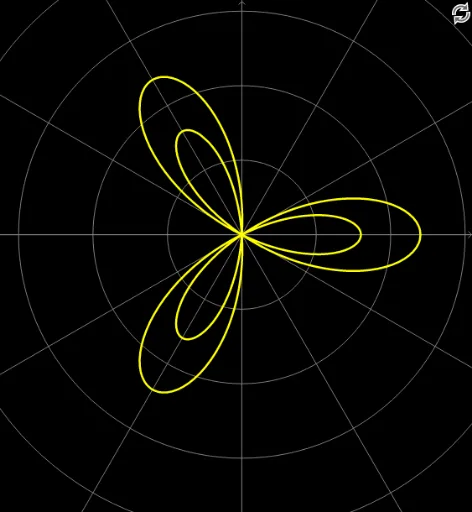
① This example demonstrates the generation of petal-like symmetric curves in polar coordinates, showing how parametric equations create beautiful geometric patterns dynamically. ② Core mathematical concepts include polar coordinates, parametric curves, power functions, isosceles triangle relationships, centroid/barycenter, and calculus ideas such as arc length or area, along with numerical computation and interactive control. ③ Construction highlights: using GeoGebra's CurveCartesian command to define the parametric curve, Point and Segment to build auxiliary points and segments, sliders (speed) and buttons (button1, button2) to control animation, and text objects (text1–text4) to display dynamic values, creating an interactive polar exploration environment. ④ Suitable for high school to undergraduate mathematics, especially for analytic geometry, introductory calculus, or math lab sessions, helping learners understand polar curves, parameterization, and dynamic geometric construction.
GeoGebra Commands & Parameters
CurveCartesian(((cos((n * t)) + c) * cos(t)), ((cos((n * t)) + c) * sin(t)), t, 0, (2 * π)) → bCurveCartesian(cos(t)^(n), sin(t)^(n), t, 0, (2 * π)) → aPoint(b) → ASegment(A, B) → gSegment(A, C) → h
AI Drawing Prompt Reference
Draw a symmetric petal-like curve generated by polar coordinate parametric equations, showing how parametric equations dynamically create beautiful geometric patterns. Focus on polar coordinates, parametric curves, power functions, isosceles triangle relationships, centroid, and calculus concepts like arc length or area. Use sliders to control animation speed, buttons for dynamic control, and text to display values, creating an interactive polar exploration environment.
The prompt above was compiled from the original drawing commands and is for reference only.