
Perspective Tesseract Demonstration
Loading the math board and drawing, please wait…
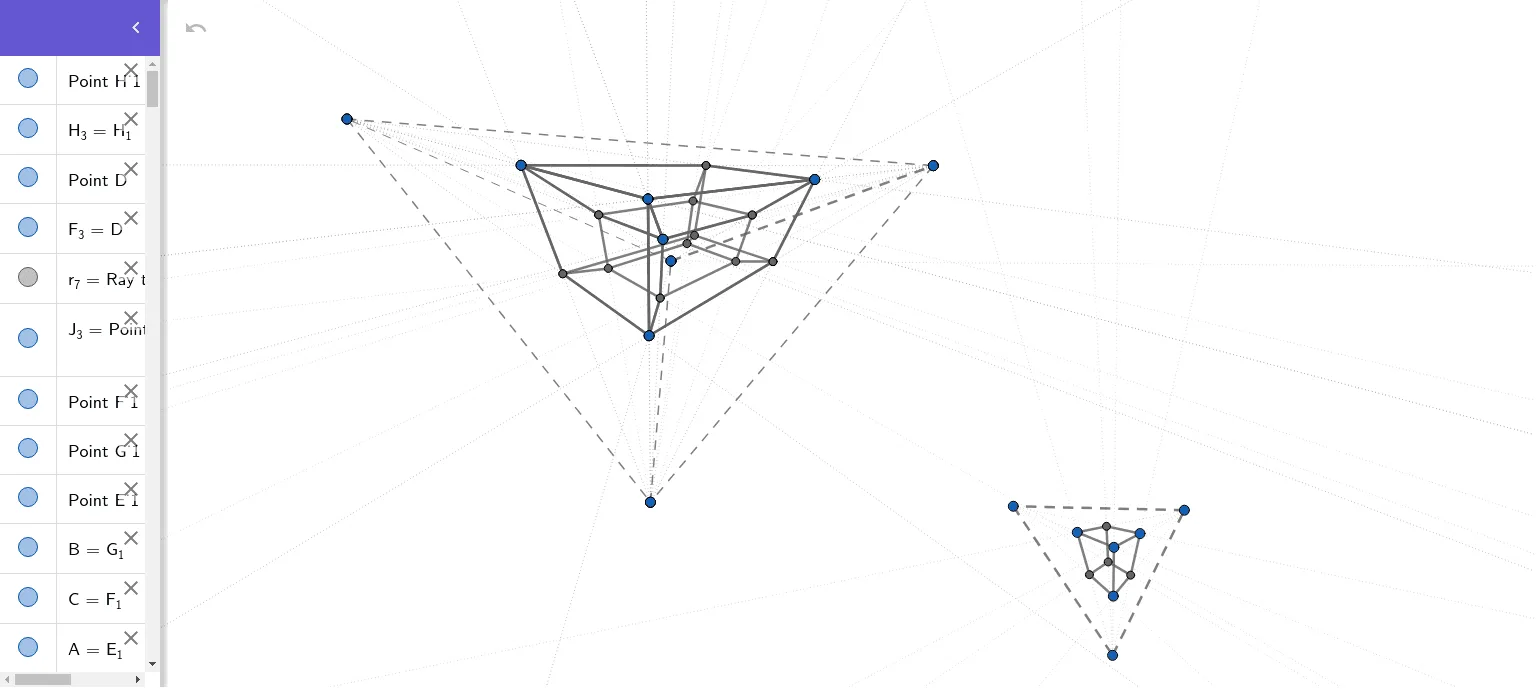
This example provides an interactive demonstration of a tesseract, showcasing its projection in 3D space. It involves core mathematical concepts such as solid geometry, matrix transformations, parametric equations, and integral calculus. The construction utilizes GeoGebra commands like Ray, Point, Segment, and Intersect, along with objects like H_1, D, F_3, etc. It is suitable for high school and above students to visualize and understand higher-dimensional geometry and spatial transformations.
GeoGebra Commands & Parameters
Ray(F_3, H_3) → r_7Point(r_7) → J_3Segment(E, G) → lSegment(G, F) → mSegment(F, E) → nRay(E, H) → pPoint(p) → ISegment(I, H) → qRay(F, H) → rPoint(r) → JSegment(H, J) → sRay(G, H) → tPoint(t) → KSegment(H, K) → aRay(G, J) → bRay(G, I) → cRay(E, K) → dRay(F, K) → eIntersect(b, e) → LSegment(L, K) → f_1Intersect(c, d) → MSegment(M, K) → g_1Segment(J, L) → h_1Segment(I, M) → i_1Ray(E, J) → j_1Ray(F, I) → k_1Intersect(j_1, k_1) → NRay(G, N) → l_1Segment(N, J) → m_1Segment(N, I) → n_1Ray(E, L) → p_1Ray(F, M) → q_1Intersect(l_1, p_1) → OSegment(O, M) → r_1Segment(O, L) → s_1Segment(N, O) → t_1Ray(E_1, H_1) → p_2Point(p_2) → I_1Segment(I_1, H_1) → q_2Ray(F_1, H_1) → r_3Point(r_3) → J_1Segment(H_1, J_1) → s_2Ray(G_1, H_1) → t_3Point(t_3) → K_1Segment(H_1, K_1) → a_1Ray(G_1, J_1) → b_1Ray(G_1, I_1) → c_1Ray(E_1, K_1) → d_1Ray(F_1, K_1) → e_1Intersect(b_1, e_1) → L_1Segment(L_1, K_1) → f_2Intersect(c_1, d_1) → M_1Segment(M_1, K_1) → g_2Segment(J_1, L_1) → h_2Segment(I_1, M_1) → i_2Ray(E_1, J_1) → j_2Ray(F_1, I_1) → k_2Intersect(j_2, k_2) → N_1Ray(G_1, N_1) → l_3Segment(N_1, J_1) → m_3Segment(N_1, I_1) → n_3Ray(E_1, L_1) → p_3Ray(F_1, M_1) → q_3Intersect(l_3, p_3) → O_1Segment(O_1, M_1) → r_2Segment(O_1, L_1) → s_3Segment(N_1, O_1) → t_2Segment(F_2, E_2) → n_4Ray(E_2, H_2) → p_4Segment(I_2, H_2) → q_4Ray(F_2, H_2) → r_5Segment(H_2, J_2) → s_4Ray(G_2, H_2) → t_5Segment(H_2, K_2) → a_2Ray(G_2, J_2) → b_2Ray(G_2, I_2) → c_2Ray(E_2, K_2) → d_2Ray(F_2, K_2) → e_2Intersect(b_2, e_2) → L_2Segment(L_2, K_2) → f_3Intersect(c_2, d_2) → M_2Segment(M_2, K_2) → g_3Segment(J_2, L_2) → h_3Segment(I_2, M_2) → i_3Ray(E_2, J_2) → j_3Ray(F_2, I_2) → k_3Intersect(j_3, k_3) → N_2Ray(G_2, N_2) → l_5Segment(N_2, J_2) → m_5Segment(N_2, I_2) → n_5Ray(E_2, L_2) → p_5Ray(F_2, M_2) → q_5Intersect(l_5, p_5) → O_2Segment(O_2, M_2) → r_4Segment(O_2, L_2) → s_5Segment(N_2, O_2) → t_4Segment(E_3, G_3) → l_6Segment(G_3, F_3) → m_6Ray(E_3, H_3) → p_6Segment(I_3, H_3) → q_6Segment(H_3, J_3) → s_6Ray(G_3, H_3) → t_7Segment(H_3, K_3) → a_3Ray(G_3, J_3) → b_3Ray(G_3, I_3) → c_3Ray(E_3, K_3) → d_3Ray(F_3, K_3) → e_3Intersect(b_3, e_3) → L_3Segment(L_3, K_3) → f_4Intersect(c_3, d_3) → M_3Segment(M_3, K_3) → g_4Segment(J_3, L_3) → h_4Segment(I_3, M_3) → i_4Ray(E_3, J_3) → j_4Ray(F_3, I_3) → k_4Intersect(j_4, k_4) → N_3Ray(G_3, N_3) → l_7Segment(N_3, J_3) → m_7Segment(N_3, I_3) → n_7Ray(E_3, L_3) → p_7Ray(F_3, M_3) → q_7Intersect(l_7, p_7) → O_3Segment(O_3, M_3) → r_6Segment(O_3, L_3) → s_7Segment(N_3, O_3) → t_6Segment(E_4, G_4) → l_8Segment(G_4, F_4) → m_8Segment(F_4, E_4) → n_8Ray(E_4, H_4) → p_8Segment(I_4, H_4) → q_8Ray(F_4, H_4) → r_9Segment(H_4, J_4) → s_8Ray(G_4, H_4) → t_9Segment(H_4, K_4) → a_4Ray(G_4, J_4) → b_4Ray(G_4, I_4) → c_4Ray(E_4, K_4) → d_4Ray(F_4, K_4) → e_4Intersect(b_4, e_4) → L_4Segment(L_4, K_4) → f_5Intersect(c_4, d_4) → M_4Segment(M_4, K_4) → g_5Segment(J_4, L_4) → h_5Segment(I_4, M_4) → i_5Ray(E_4, J_4) → j_5Ray(F_4, I_4) → k_5Intersect(j_5, k_5) → N_4Ray(G_4, N_4) → l_9Segment(N_4, J_4) → m_9Segment(N_4, I_4) → n_9Ray(E_4, L_4) → p_9Ray(F_4, M_4) → q_9Intersect(l_9, p_9) → O_4Segment(O_4, M_4) → r_8Segment(O_4, L_4) → s_9Segment(N_4, O_4) → t_8Ray(E_1, O_2) → a_5Ray(F_1, O_3) → b_5Ray(D, O_1) → c_5Intersect(a_5, b_5) → PSegment(P, O_3) → d_5Segment(O_2, P) → e_5Segment(O_1, P) → f_6Ray(G_1, P) → g_6Segment(O_4, P) → h_6