
Perimeters and Areas of Similar Polygons by Rasha Tarek
Loading the math board and drawing, please wait…
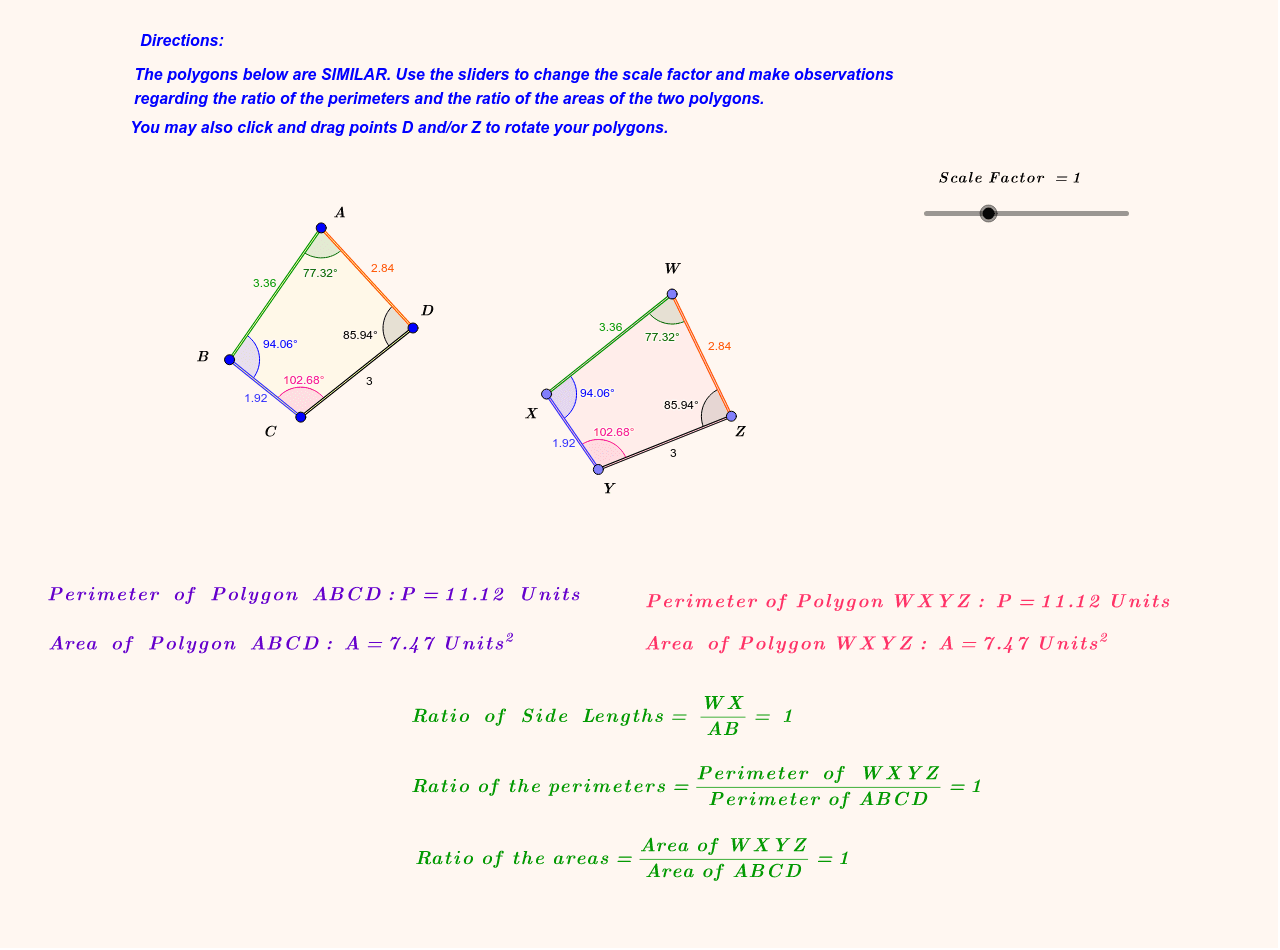
This example demonstrates the relationship between the perimeters and areas of similar polygons. Key mathematical concepts include the properties of similar polygons, perimeter and area calculations. It uses GeoGebra commands such as Circle, Rotate, Segment, Radius, Point, Angle, Polygon, Area, and Perimeter for geometric construction. Suitable for students at the junior high school level and above.
GeoGebra Commands & Parameters
Circle(A, B) → cRotate(B, 33, A) → B'Rotate(B', 2, A) → B''Rotate(B'', 1, A) → B'''Segment(B, B') → aSegment(B', B'') → bSegment(B'', B''') → dSegment(B''', B) → eRadius(c) → gCircle(C, (f * g)) → hPoint(h) → DRotate(D, 33, C) → D'Rotate(D', 2, C) → D''Rotate(D'', 1, C) → D'''Segment(D, D') → iSegment(D', D'') → jSegment(D'', D''') → kSegment(D''', D) → lAngle(B'', B', B) → αAngle(B, B''', B'') → βAngle(B''', B'', B') → γAngle(B', B, B''') → δAngle(D'', D', D) → εAngle(D', D, D''') → ζAngle(D, D''', D'') → ηAngle(D''', D'', D') → θPolygon(B', B, B''', B'') → poly1, b', b_1, b''', b''Polygon(D', D, D''', D'') → poly2, d', d_1, d''', d''Area(poly1) → Area_1Area(poly2) → Area_2Perimeter(poly1) → Perimeter_1Perimeter(poly2) → Perimeter_2
AI Drawing Prompt Reference
Draw two similar quadrilaterals, one larger and one smaller, with corresponding sides parallel and proportional. Start with a circle, pick a point on it, then rotate this point around the center by 33, 2, and 1 degrees successively to get four points, and connect them to form the first quadrilateral. Then draw a second circle centered at another point with a radius that is a scaled multiple of the first circle's radius. Pick a point on this second circle, rotate it by the same angles (33, 2, 1 degrees) to get four points, and connect them to form the second quadrilateral. Ensure corresponding angles are equal and sides are proportional. Finally, compute and display the area and perimeter of both quadrilaterals to illustrate the relationship between perimeters and areas of similar polygons.
The prompt above was compiled from the original drawing commands and is for reference only.