
Pascal's Triangle
Loading the math board and drawing, please wait…
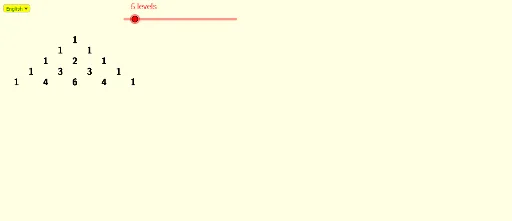
This example demonstrates the construction and properties of Pascal's Triangle, dynamically showing its generation process. Core mathematical concepts include sequences, combinatorics, and the binomial theorem. GeoGebra commands and objects used are Sequence, Join, Take, TableText, SelectedIndex, along with R, Space, PascalBase, PascalList, TPascal, PascalTriangle, PascalText, Bahasa, n, and Point (dependent). It is suitable for high school mathematics teaching to understand sequence patterns and combinatorial applications.
GeoGebra Commands & Parameters
Sequence(Join[Take[IterationList[Insert[n, {}, 1], n, {""}, p], 2]], p, R, 1, -1) → SpaceSequence(Join[{Join[{Space(t), {1, ""}}], Join[Sequence[{nPr[t - 1, p] / p!, ""}, p, 1, t - 2]], {1}}], t, 3, R) → PascalBaseJoin({{{1}}, {{1, 1}}, Sequence[Join[{{1}, Sequence[nPr[t - 1, p] / p!, p, 1, t - 2], {1}}], t, 3, R]}) → PascalListTake(Text[PascalList], 2, Length[Text[PascalList]] - 1) → TPascalJoin({{Join[{Space(1), {1}}], Join[{Space(2), {1, "", 1}}]}, PascalBase}) → PascalTriangleTableText(PascalTriangle, "hc") → PascalTextSelectedIndex(Bahasa) → n